Sun, November 29, 2026
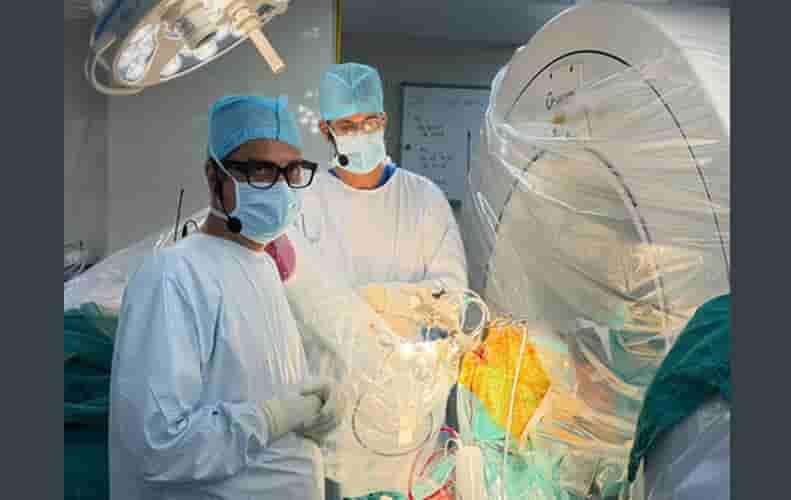
Photo: IANS
New Delhi: Doctors at the All India Institute of Medical Sciences (AIIMS), New Delhi, have achieved a major milestone in neurological treatment by performing India's first robotic-guided deep brain stimulation (DBS) procedure on a patient suffering from Parkinson's disease.
The public medical institution announced the achievement on Saturday, stating that the procedure was conducted in collaboration with Tel Aviv University, Israel. The surgical team was led by Prof. P. Sarat Chandra of AIIMS and Prof. Ido Straus of Tel Aviv University, with contributions from Prof. Ela Varsi, Prof. Manjari Tripathi and teams from the Departments of Neurosurgery and Neurology.
The use of robotic guidance enables doctors to place stimulation electrodes with greater precision in specific regions of the brain. This accuracy is particularly important in DBS procedures, where even small variations in electrode positioning can influence treatment outcomes.
Deep brain stimulation involves implanting electrodes in targeted areas of the brain to deliver controlled electrical impulses that modify abnormal brain activity associated with certain neurological conditions. The electrodes are connected through wires beneath the skin to a small battery-powered device, similar to a pacemaker, implanted in the upper chest. The device regulates the electrical stimulation.
DBS is an established treatment option for patients with Parkinson's disease and is also used to manage essential tremors and dystonia, a group of neurological disorders characterised by involuntary muscle contractions. In selected cases, the procedure is also used to treat epilepsy, obsessive-compulsive disorder and Tourette syndrome, which causes repetitive movements and vocal sounds.
The latest achievement adds to AIIMS Delhi's ongoing work in advanced neurological treatment and surgical research. Earlier this month, the institute's Department of Neurosurgery announced a pilot study that developed a novel technique aimed at slowing the progression of glioblastoma, an aggressive brain tumour that primarily affects adults, while patients await potentially life-saving surgery.
In another development highlighting the growing use of technology in healthcare, the Digital India BHASHINI Division (DIBD), under the Ministry of Electronics and Information Technology (MeitY), showcased BHASHINI's speech technology at the Global Digital Health Summit 2026.
The technology is being used at AIIMS to facilitate communication between doctors and patients who speak different languages. It can also convert doctors' spoken clinical notes into written text, supporting voice-based medical documentation.
Together, these developments reflect the increasing integration of robotics, artificial intelligence and advanced medical technologies into India's healthcare system, with the potential to improve surgical precision, clinical efficiency and patient care.



© Copyright
Reporter Post.All Rights Reserved |
Powered by: Aptilogic Software |
 |
Page rendered in 0.0118 seconds.