Thu, November 26, 2026

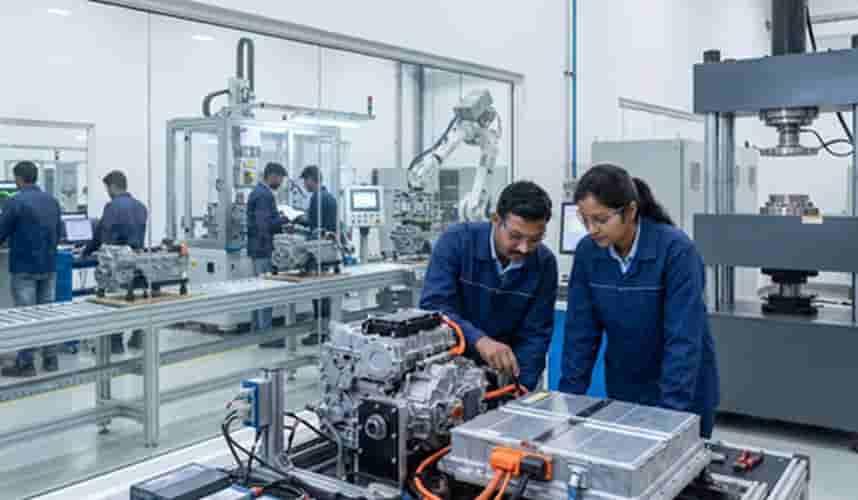
Photo: IANS
Kolkata: The Indian Institute of Technology (IIT) Madras will host a two-day national dialogue on January 21 and 22, 2027, to address the major challenges holding back the adoption of electric commercial vehicles in India and explore ways to accelerate the transition to cleaner freight transportation.
Organised under the patronage of the Office of the Principal Scientific Adviser to the Government of India, the 'eCV Dialogue' will bring together policymakers, industry leaders, fleet operators and researchers to develop practical solutions for expanding the use of electric trucks across the country.
The discussions will focus on why electric commercial vehicles have struggled to gain market share compared to electric passenger vehicles and what needs to be done to move the transition beyond technological development towards coordinated action involving government and industry.
"With medium and heavy-duty vehicles contributing nearly 25 per cent of India's oil import bill, accelerating their electrification is crucial to strengthening energy security. Yet, electric trucks account for just 0.2 per cent of N3 commercial vehicle sales," IIT Madras said in a statement.
The two-day conclave will examine key issues, including policy frameworks, charging infrastructure, vehicle technologies, financing arrangements and long-term transition strategies. Drawing inspiration from the Indian tradition of *Shastrartha*, the event aims to encourage constructive debate and translate diverse perspectives into actionable recommendations.
Unlike conventional industry discussions, the dialogue intends to produce specific outcomes, including policy proposals, standard operating procedures for charging networks, battery and vehicle safety standards, and financial incentives such as toll waivers and mechanisms to support net-zero transitions.
Despite government incentives and policy initiatives, electric trucks continue to face several obstacles in gaining wider acceptance. They accounted for only around 3.14 per cent of overall truck registrations in India in early FY2027, reflecting the gap between policy ambitions and market adoption.
High upfront vehicle costs remain one of the biggest barriers, as electric trucks are significantly more expensive to acquire than their diesel-powered counterparts. Fleet operators also face commercial challenges, with industrial shippers often offering lower per-tonne freight rates for electric vehicles than for diesel trucks. This puts pressure on operating margins, while cautious lending practices and less favourable financing terms from banks further complicate fleet electrification.
Charging infrastructure and vehicle utilisation present additional challenges, particularly for long-distance highway transportation. Consequently, electric commercial vehicle adoption has largely remained concentrated in light goods transportation and predictable, closed-loop operations such as ports, mining, cement transport and mid-mile logistics.
The Centre has been seeking to encourage the adoption of electric trucks in the N2 and N3 categories through incentives under the PM E-DRIVE scheme. However, industry stakeholders maintain that the economics of electric trucking currently work best on fixed and repeatable routes where reliable depot charging facilities or battery-swapping infrastructure are available.
Another major concern is the trade-off between battery weight, driving range and payload capacity. Heavy battery packs can reduce the amount of cargo a truck can carry, affecting operational efficiency, particularly on routes involving varying terrain and load conditions.
The IIT Madras initiative is expected to provide a platform for addressing these interconnected challenges and developing a coordinated roadmap for India's electric freight sector. The focus will be on making electric trucking commercially viable while reducing the country's dependence on imported fossil fuels and lowering emissions from road transportation.



© Copyright
Reporter Post.All Rights Reserved |
Powered by: Aptilogic Software |
 |
Page rendered in 0.0103 seconds.