
Mon, May 11, 2026

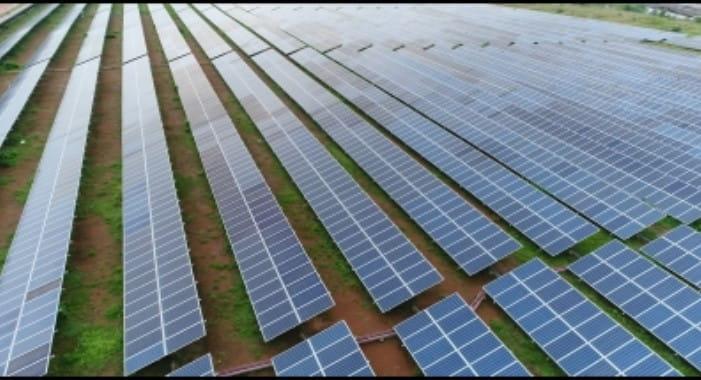
New Delhi: India has become the world’s third-largest country in terms of installed renewable energy capacity, but experts say the long-term success of the clean energy transition will depend on strengthening domestic manufacturing in key upstream sectors such as solar cells, wafers and polysilicon.
According to a report by Morgan Stanley, renewable energy has become a central part of India’s medium-term strategy to reduce dependence on imported fossil fuels and improve economic resilience.
The report noted that India’s domestic solar module manufacturing capacity has expanded rapidly due to government support through Production Linked Incentive (PLI) schemes and customs duties. Data from the Ministry of New and Renewable Energy showed that solar module manufacturing capacity increased from 38 GW in March 2024 to 74 GW in March 2025. During the same period, solar cell manufacturing capacity rose from 9 GW to 25 GW.
Despite this progress, the report pointed out that India still depends heavily on imports for upstream components such as solar cells, wafers and polysilicon. In FY2025, the country imported nearly 35 million solar modules worth around 1.6 billion US dollars, with an estimated 60 to 80 percent sourced from China.
The report stated that although renewable energy reduces dependence on fossil fuels, it does not completely remove exposure to foreign supply chains, particularly in the solar manufacturing ecosystem where China continues to dominate.
India’s non-fossil fuel installed power capacity has now crossed 50 percent of the country’s total installed capacity, reaching 262.7 GW by November 2025. Solar energy contributed 132.9 GW, while wind energy accounted for 54 GW of the total additions.
The report highlighted that India achieved its target of 50 percent non-fossil fuel capacity five years ahead of schedule. The achievement was supported by large-scale renewable energy expansion, distributed solar schemes such as PM Surya Ghar and PM-KUSUM, along with continued policy support for grid integration.
Morgan Stanley said the rapid growth in renewable energy is helping India reduce the import intensity of economic growth, as every increase in domestic solar and wind generation lowers the country’s reliance on imported fossil fuels.
With inputs from IANS




| 14-09-2018 | ||||||
| Sl No. | Parameters | Actual Data(µg/m3) | Standard Limit(µg/m3) |
|---|---|---|---|
| 1 | PM 10 | 64 | 100 |
| 2 | PM 2.5 | 33 | 60 |
| 3 | SO2 | 55.3 | 80 |
| 4 | NO2 | 58.2 | 80 |
| 14-09-2018 | ||||||
| Station | Temperature(degree centigrade) | Rainfall(mm) | Relative humidity(%) | |||
|---|---|---|---|---|---|---|
| Max | Min | Past 24 hrs. | Since 1st March, 2018 | Max | Min | |
| Ranchi | 31.0 | 22.5 | 000.0 | 1010.1 | 95 | 66 |
| Jamshedpur | 34.1 | 26.2 | 000.0 | 1252.8 | 87 | 58 |
| Bokaro | 33.5 | 24.6 | 015.2 | 824.0 | 92 | 79 |
| Daltonganj | 32.6 | 24.9 | 004.2 | 960.9 | 95 | 67 |
© Copyright
Reporter Post.All Rights Reserved |
Powered by: Aptilogic Software |
 |
Page rendered in 0.0947 seconds.
|
Page rendered in 0.0947 seconds.