Tue, October 27, 2026

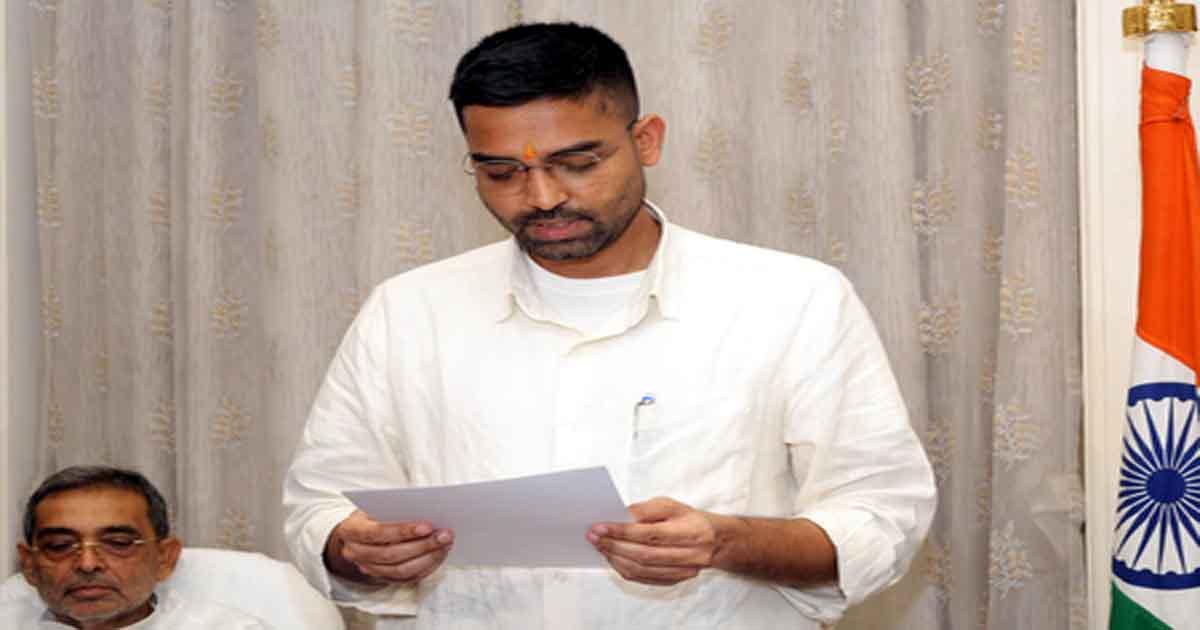
Photo: IANS
The Supreme Court on Friday asked the Bihar government to place on record the notification appointing Panchayati Raj Minister Deepak Prakash as a member of the Bihar Legislative Council after the state informed the court that he had been nominated to the Upper House and had already taken oath.
A Bench headed by Chief Justice of India Surya Kant and comprising Justices Joymalya Bagchi and V Mohana took note of the submission made by the Bihar government regarding Prakash’s appointment as an MLC.
Solicitor General Tushar Mehta, appearing for the Bihar government, argued that the issue of Prakash’s alleged disqualification no longer survived because he had since become a member of the Legislative Council.
The Supreme Court, however, directed the state to produce the official notification concerning his appointment and adjourned the public interest litigation filed by social activist Rakesh Kumar Singh.
The Bihar government had urged the court to close the case in view of the subsequent development. The petitioner opposed the request, arguing that the alleged constitutional violation had already taken place and questioning the legality of the process through which Prakash continued in office.
According to the Supreme Court’s case status, the matter is likely to come up next on August 20.
Case revolves around six-month constitutional limit
The controversy concerns Prakash’s continuation as Panchayati Raj Minister despite initially not being a member of either House of the Bihar legislature.
Under Article 164(4) of the Constitution, a person who is not a member of the state legislature can be appointed as a minister, but must become a member of either the Legislative Assembly or Legislative Council within six months.
During an earlier hearing, the Supreme Court had asked the Bihar government to explain the constitutional basis for allowing Prakash to continue as a minister after the six-month period had expired.
The Bench had observed that the case raised a question of law after the petitioner’s counsel argued that Prakash had remained a minister beyond the constitutionally prescribed period without being elected or nominated to either House.
The court had earlier issued notice on the PIL challenging Prakash’s reappointment as Panchayati Raj Minister following the formation of the new Bihar government.
Petitioner relies on 2001 Supreme Court ruling
According to the petition, Prakash was first inducted into the Bihar Cabinet on November 20, 2025, despite not being a member of either House.
Following the resignation of then Chief Minister Nitish Kumar on April 15 and the formation of a new government headed by Chief Minister Samrat Choudhary, Prakash was reappointed as Panchayati Raj Minister on May 7.
The petitioner argued that the fresh appointment could not be used to give Prakash another six-month period under Article 164(4), particularly because the same Legislative Assembly remained in existence.
The plea relies on the Supreme Court’s 2001 judgment in S.R. Chaudhuri versus State of Punjab, arguing that the six-month constitutional provision cannot be repeatedly used by an unelected person through resignation, Cabinet reshuffles or reappointment.
According to the petitioner, allowing such repeated appointments could undermine the principles of representative government, parliamentary democracy, collective responsibility and electoral accountability.
MLC appointment changes immediate situation
The controversy took a new turn after Prakash was not included among the NDA candidates for the vacant Bihar Legislative Council seats in the recent elections.
On July 31, BJP MLC Devesh Kumar resigned from his Legislative Council seat, creating a vacancy. Prakash was subsequently nominated to the Bihar Legislative Council under the Governor’s quota and has since taken the oath as an MLC.
The Bihar government has relied on this development to argue that the constitutional issue concerning Prakash’s continuation as a minister has effectively been resolved.
The Supreme Court’s decision to seek the appointment notification indicates that it will first examine the official record before deciding how the pending PIL should proceed.



© Copyright
Reporter Post.All Rights Reserved |
Powered by: Aptilogic Software |
 |
Page rendered in 0.0075 seconds.
|
Page rendered in 0.0075 seconds.