Mon, October 12, 2026
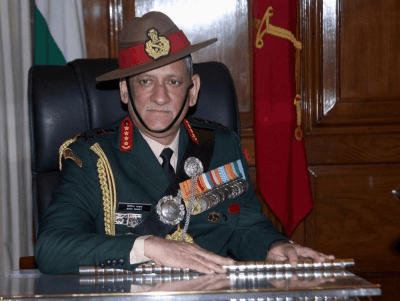
image courtesy ians
Indian Army Chief General Bipin Rawat on Tuesday said soldiers should not be completely denied access to social media, arguing that smartphones and online platforms have become an integral part of modern communication and information warfare.
Speaking at a seminar on "Social Media and Armed Forces", General Rawat said the Army needed to adapt to the rapid growth of social media instead of trying to keep soldiers away from it.
"The social Media gaining momentum faster than we thought. (If we don't catch up) we will be left far behind and we will be firefighting again," he said.
Rawat described information as an important component of national power and said the armed forces could not afford to remain disconnected from developments in the digital space.
He questioned whether it was practical to prevent soldiers from using smartphones, particularly when they could access them at home and their family members could also use social media.
"If you can't prevent usage of smartphone, it is best to allow it (the access to social media)," he said, while stressing that such access should operate within a clearly defined system of discipline and safeguards.
According to the Army Chief, social media could be exploited by India's adversaries for psychological warfare, propaganda and deception. Rather than simply treating these platforms as a security threat, he said the Army should learn to use them to its own advantage.
"The social media is here to stay. Soldiers will use the social media. Our adversary will use the social media for psychological warfare and deception. We must leverage it to our advantage," Rawat said.
He also pointed to the potential role of social media in countering proxy warfare and cross-border terrorism. At the same time, he emphasised the need for mechanisms to ensure that soldiers follow strict rules while using online platforms.
Interestingly, Rawat said he did not personally own a mobile phone. He joked that when people asked for his number, he would sometimes give them a random number and tell them to remove the last digit if it turned out to have 11 digits.
However, he said his personal choice should not determine whether the wider Army has access to modern communication tools.
Rawat also linked social media with emerging technologies such as Artificial Intelligence (AI). He said information available through social platforms could become increasingly important for AI-driven analysis and intelligence gathering, making it necessary for the armed forces to remain engaged in the digital ecosystem.
The Army Chief's comments came months after concerns over social media security were heightened following reports that a senior Army officer had allegedly been honey-trapped by an ISI operative through Facebook.
The Defence Ministry had subsequently issued guidelines governing social media use by military personnel. Among other restrictions, soldiers were advised against using photographs in uniform as profile pictures on platforms such as WhatsApp and Facebook.
The guidelines also prohibited personnel from clicking on suspicious advertisements offering prizes or awards, revealing official identities or sensitive information such as rank, unit and location, and sharing details related to their work.
Soldiers were also advised against accepting friend requests from unknown people.
Rawat's remarks therefore pointed towards a more balanced approach: rather than attempting to eliminate social media use among soldiers, the Army could seek to combine controlled access, cybersecurity awareness and operational discipline with the strategic advantages offered by digital platforms.


© Copyright
Reporter Post.All Rights Reserved |
Powered by: Aptilogic Software |
 |
Page rendered in 0.0141 seconds.
|
Page rendered in 0.0141 seconds.