Thu, October 08, 2026

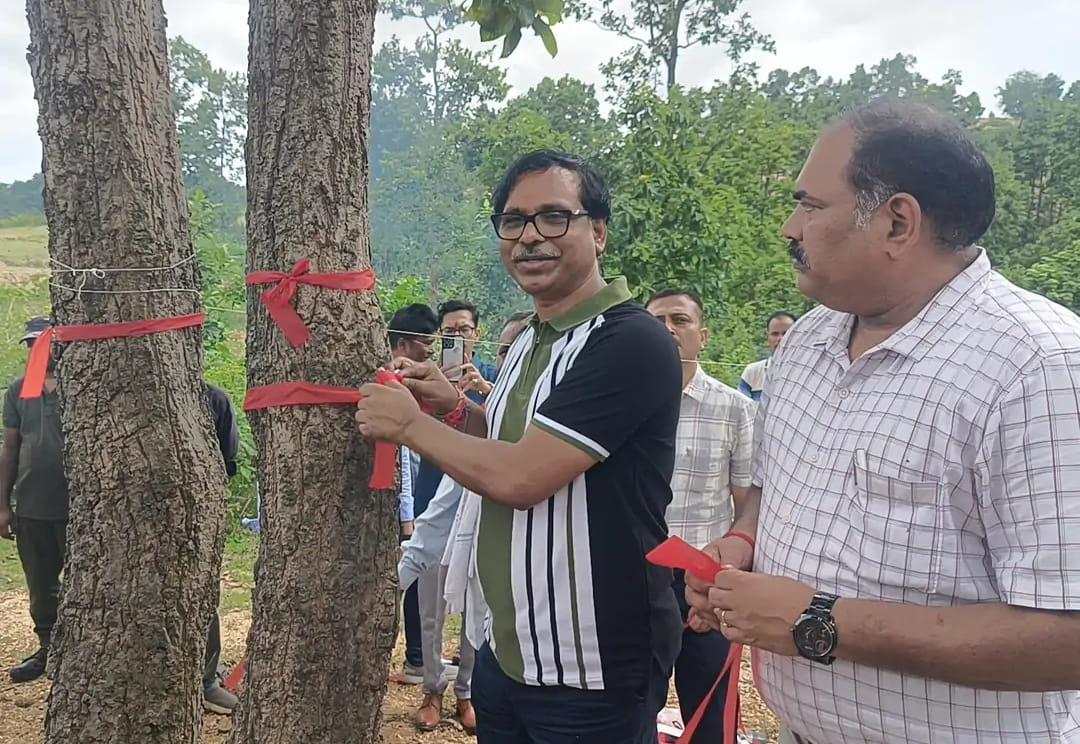
Photo: Reporter Post
Raksha Bandhan took on a different meaning in Gumla as villagers tied rakhis to trees and pledged to protect forests and the natural resources on which their lives and livelihoods depend.
The initiative was organised by the Gumla Forest Division at Jorag Anjan and Tari villages in the Sadar block. Along with celebrating the traditional bond between brothers and sisters, villagers extended the spirit of protection to nature by tying a raksha sutra around trees.
Jharkhand Principal Chief Conservator of Forests (PCCF) Sanjeev Kumar, Gumla Divisional Forest Officer Belal Ahmad, forest committee representatives and hundreds of villagers attended the programme.
PCCF Sanjeev Kumar formally launched the ‘Save Trees’ campaign at Jorag village by tying a rakhi to a tree. He said Raksha Bandhan represents a promise of protection and trust, and the same sentiment can be extended to nature.
Human life, he said, is closely dependent on forests and natural resources. Protecting trees and forests is therefore essential to ensure that future generations have access to clean air, water and a healthy environment.
One-Month Campaign Across Jharkhand
Kumar said the ‘Save Trees’ campaign will continue for a month across Jharkhand. As part of the initiative, around three lakh trees in selected villages across all 24 districts of the state are expected to be tied with rakhi.
The campaign aims to encourage greater community participation in forest protection, create awareness about preventing illegal tree felling and promote the responsible use and conservation of natural resources.
Forest committee president Chandramohan Oraon said villagers in the Jorag area have been tying rakhis to trees on Raksha Bandhan and taking a pledge to protect them for nearly a decade.
For the villagers, the forest is not simply a source of greenery. It is closely connected to their everyday lives and income. Besides providing clean air and oxygen, forest produce such as mahua, tamarind and sal seeds provides an important source of livelihood for many families.
A Tradition That Began in Dhanbad
According to Sanjeev Kumar, the practice of tying rakhi to trees as a conservation initiative began in 2004 in Lukaiya village of Tundi block in Dhanbad district.
At the time, the area was considered affected by Maoist activities. The initiative gradually spread to other villages as local communities adopted the idea of treating trees as something that also deserved protection.
More than 12,000 villages have since been connected with the campaign, according to the forest department.
Kumar said the initiative in Lukaiya helped protect more than 20,000 mahua trees. These trees have now become an important source of livelihood for local residents. The campaign has also encouraged the protection and production of minor forest produce in several villages, helping improve rural incomes.
At the Gumla programme, villagers tied rakhis to trees and pledged to prevent unnecessary tree cutting, protect forests and plant more saplings.
The Forest Department appealed to residents to make forest conservation a community movement and incorporate environmental protection into their everyday lives. The initiative gave Raksha Bandhan a wider message — that the idea of protection can extend beyond human relationships to the forests and natural resources that sustain entire communities.



© Copyright
Reporter Post.All Rights Reserved |
Powered by: Aptilogic Software |
 |
Page rendered in 0.0107 seconds.
|
Page rendered in 0.0107 seconds.