Thu, October 22, 2026
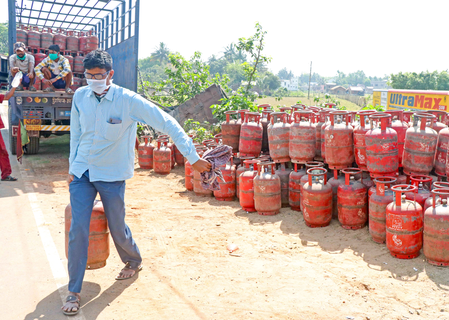
New Delhi: The government has ramped up domestic LPG production by 28 per cent over the past five days, while maintaining normal delivery timelines, Union Petroleum and Natural Gas Minister Hardeep Singh Puri informed Parliament on Thursday.
Speaking in the Lok Sabha, the minister said refinery operations had been directed to boost production and additional procurement efforts were underway to ensure uninterrupted supply across the country.
Puri emphasised that the government’s priority is to ensure that the kitchens of more than 33 crore households, particularly poor and vulnerable families, continue to receive cooking gas without disruption.
“The standard time between booking and delivery of domestic LPG cylinders remains around 2.5 days, the same as before the current situation,” he said. He also assured that hospitals and educational institutions have been placed under priority supply and will continue to receive LPG without interruption.
According to the minister, recent reports from the field suggest that hoarding and panic booking by consumers at the distributor level are driving sudden spikes in demand in some areas, rather than any real shortage of supply.
To strengthen monitoring and prevent diversion of cylinders, the government is expanding the Delivery Authentication Code system. The coverage will increase from about 50 per cent of consumers to nearly 90 per cent. Under this system, a cylinder is marked as delivered only after the consumer confirms receipt through a one-time code sent to their registered mobile number.
The government has also introduced booking restrictions to manage demand. In urban areas, consumers must wait at least 25 days between bookings, while in rural and remote regions the minimum gap has been fixed at 45 days.
Officials from oil marketing companies are working with enforcement teams, including the Anti-Adulteration Cell, to monitor distributors and prevent irregularities. The Union Home Secretary has also convened a meeting with state Chief Secretaries to coordinate efforts between central and state authorities.
Puri clarified that measures taken in the commercial LPG segment are intended to prevent black marketing rather than restrict legitimate users such as restaurants and hotels. Unlike domestic LPG, commercial cylinders are sold in a deregulated market at prevailing prices without subsidy or a booking system.
To prevent misuse, the government has introduced regulated allocation for commercial cylinders. A three-member committee comprising senior executives from Indian Oil Corporation, Hindustan Petroleum, and Bharat Petroleum was set up on March 9 to assess sector-wise and regional demand.
Based on its recommendations, oil marketing companies have begun allocating 20 per cent of the average monthly commercial LPG requirement in coordination with state governments to ensure supply reaches genuine users and to curb hoarding.
The minister also noted that alternative fuel options are being promoted to ease pressure on LPG supply channels.
Currently, the non-subsidised LPG price stands at Rs 913 after a recent Rs 60 adjustment, while the market-linked price is estimated at about Rs 987. The government has absorbed Rs 74 of the Rs 134 price increase caused by global market trends, limiting the additional burden on beneficiaries of the Pradhan Mantri Ujjwala Yojana to less than 80 paise per day per household.
Puri added that LPG prices remain higher in neighbouring countries, with cylinders costing around Rs 1,046 in Pakistan, Rs 1,242 in Sri Lanka, and Rs 1,208 in Nepal.
The government has also approved compensation of Rs 30,000 crore for oil marketing companies against losses estimated at around Rs 40,000 crore during the 2024–25 financial year, the minister said.
With inputs from IANS


© Copyright
Reporter Post.All Rights Reserved |
Powered by: Aptilogic Software |
 |
Page rendered in 0.0173 seconds.
|
Page rendered in 0.0173 seconds.