Sun, October 04, 2026

New Delhi: Strong policy continuity, institutional clarity, and a rapidly expanding public-private partnership framework propelled the growth of India’s private space sector in 2025, according to Lt. Gen. A.K. Bhatt (Retd.), Director General of the Indian Space Association (ISpA).
Bhatt described 2025 as a turning point for the Indian space ecosystem, noting that policy reforms introduced in recent years translated into concrete execution across launch services, satellite manufacturing, Earth observation, space data applications, and satellite communications.
He said the year’s momentum was largely driven by private industry participation, with visible progress in contract awards, establishment of production facilities, satellite deployments, advancement of launch vehicles towards operational readiness, and the scaling up of data-driven services across civilian, commercial, and strategic sectors.
India’s space economy, currently valued at around $9 billion, is now firmly positioned on a growth path toward an estimated $44 billion over the next decade. Public-private partnerships emerged as the dominant operating model across the entire space value chain in 2025. India’s share of the global space economy, presently about 2 per cent, is expected to rise to nearly 8 per cent by 2033, primarily led by private enterprises.
Bhatt highlighted that enabling policy measures such as the New Space Policy 2023, the liberalised Foreign Direct Investment (FDI) Policy of 2024, and the implementation of the Indian Telecommunications Act 2023 provided stability and predictability for long-term private investments. Simplified FDI norms and the single-window authorisation mechanism of IN-SPACe further encouraged participation from both domestic and international players.
The Indian space ecosystem also achieved a significant scale milestone in 2025, with more than 300 active space startups operating across diverse segments including launch vehicles, satellite platforms, Earth observation, satellite communications, propulsion systems, electronics, space situational awareness, and downstream analytics.
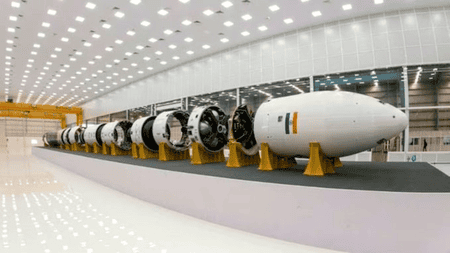
Private companies moved decisively from demonstration to deployment during the year. Skyroot Aerospace and Agnikul Cosmos continued to advance their private orbital and semi-cryogenic launch systems, contributing to the emergence of a competitive domestic launch market. Prime Minister Narendra Modi recently unveiled Skyroot’s Vikram-I launch vehicle along with the company’s Infinity Campus.
In satellite deployment, Pixxel launched India’s first private satellite constellation—the Firefly series—using SpaceX Falcon 9 rockets in early and mid-2025. The launches placed six hyperspectral satellites into orbit, enabling high-resolution Earth imaging capabilities.
Digantara strengthened India’s space situational awareness capabilities by launching its first commercial space surveillance satellite, SCOT. Other companies such as Bellatrix Aerospace, ThrustWrks, OmSpace, Xovian, and GalaxEye demonstrated operational progress across propulsion technologies, launch subsystems, and advanced imaging platforms.
Policy backing was further reinforced in the Union Budget 2025–26 through initiatives including the National Geospatial Mission, a Fund of Funds for startups, enhanced credit guarantee mechanisms, expansion of Atal Tinkering Labs, and the creation of a dedicated DeepTech Fund of Funds.
Financial momentum also remained strong, with Indian private space startups raising nearly $150 million during FY 2025, taking total funding in the sector to over $617 million to date. The operationalisation of the Rs 1,000 crore IN-SPACe Venture Capital Fund and the approval of the Rs 1 lakh crore Research, Development and Innovation Scheme added long-term depth to the funding ecosystem for space and deep-tech innovation.
Additionally, the Rs 500 crore Technology Adoption Fund launched by IN-SPACe in 2025 is expected to accelerate private sector innovation by supporting startups and MSMEs with funding of up to 60 per cent of project costs to develop commercially viable early-stage space technologies.
With inputs from IANS



© Copyright
Reporter Post.All Rights Reserved |
Powered by: Aptilogic Software |
 |
Page rendered in 0.0107 seconds.
|
Page rendered in 0.0107 seconds.