Tue, October 13, 2026

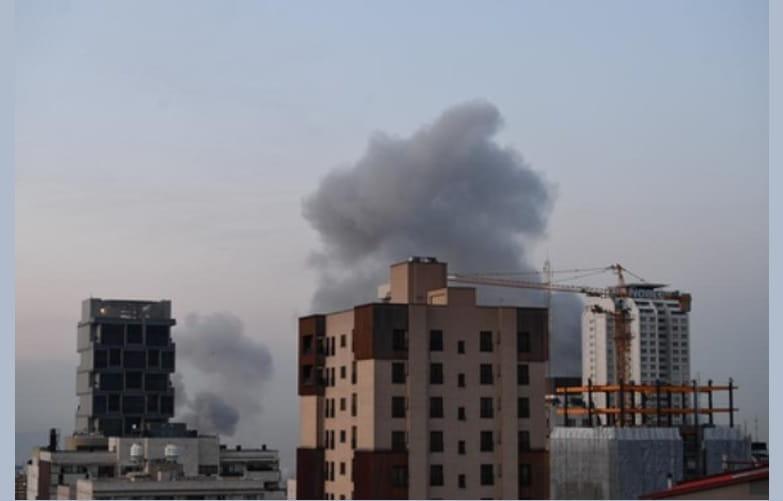
Photo: IANS
Iran has launched retaliatory missile and drone attacks against US military positions in the Middle East, sharply escalating the latest confrontation after American forces carried out strikes on targets inside southern Iran.
The Islamic Revolutionary Guard Corps (IRGC) said its “regret-inducing response” had begun after US attacks that Iranian authorities said killed at least five people and wounded more than 50 others, including casualties at a wedding gathering in Hormozgan province.
The IRGC said its aerospace forces targeted Camp Titin in Jordan and Sheikh Isa Air Base in Bahrain with ballistic missiles and drones. It also claimed that a US MQ-9 Reaper drone had been shot down.
Iranian forces claimed that the attacks caused substantial damage and casualties among US personnel. Those claims, however, were not independently confirmed. Jordanian authorities said their air-defence systems intercepted 10 of 13 ballistic missiles that entered the country’s airspace, while the remaining three fell in remote areas. No casualties were reported by Jordan.
US officials also disputed Iranian claims of major damage or casualties at Camp Titin.
The latest exchange follows a new wave of US strikes against Islamic Revolutionary Guard Corps targets inside Iran. US Central Command said the operation targeted military infrastructure, including air-defence systems, mine-laying capabilities and communications facilities, following what Washington described as Iranian attacks or attempted attacks against commercial shipping in the Strait of Hormuz and US personnel in the region.
The most serious reported civilian incident occurred in Kuhestak in Sirik County, Hormozgan province, where shrapnel from a US missile reportedly struck a residential building hosting a wedding celebration. Iranian authorities said at least five people, including a child, were killed and more than 50 wounded. Other reports have put the number of wounded at 63.
The US strikes triggered explosions across several locations in southern Iran, including areas around Bandar Abbas, Qeshm, Jask, Chabahar, Konarak, Jiroft and Asaluyeh.
Iran’s military command, Khatam al-Anbiya Central Headquarters, warned that the Iranian armed forces would deliver what it called “crushing and shattering” blows against the United States.
The Strait of Hormuz has emerged as the most dangerous flashpoint in the confrontation. Iran has warned that continued US military action could prolong the disruption of the strategically vital waterway, through which a significant share of global oil shipments normally passes.
Iranian forces have also reported attacks against US-linked positions in the wider Gulf, including facilities in Bahrain and the UAE. Iran’s military said drones targeted radar installations and areas where US forces were stationed at Bahrain’s Sheikh Isa Air Base and the UAE’s Al Dhafra and Al Minhad air bases.
The widening geography of the attacks raises the risk that the confrontation could move beyond direct US-Iran exchanges and draw additional Gulf states into the conflict.
For Washington, the immediate challenge is to prevent attacks on its forces and protect shipping routes without triggering a wider regional war. For Tehran, the ability to threaten US military infrastructure and disrupt the Strait of Hormuz remains one of its most important sources of strategic leverage.
With both sides now trading direct attacks and issuing threats of further escalation, the latest violence threatens to turn a renewed military confrontation into a much broader regional crisis.



© Copyright
Reporter Post.All Rights Reserved |
Powered by: Aptilogic Software |
 |
Page rendered in 0.013 seconds.
|
Page rendered in 0.013 seconds.