Fri, October 23, 2026

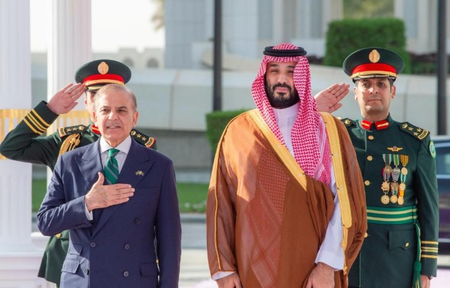
Pakistan’s decision not to deploy significant military support to Saudi Arabia amid recent tensions in West Asia has sparked debate over the reliability and scope of its defence commitments, according to a report published by Atalayar.
Despite escalating hostilities involving Iran and Saudi Arabia, Islamabad has so far refrained from activating its obligations under a recently signed Strategic Mutual Defence Agreement with Riyadh. The pact is designed to ensure mutual military support in the event of external threats, but the current crisis appears to have exposed its practical limitations.
The report, authored by Moroccan researcher and journalist Fatima El Hashimi, notes that this inaction has raised concerns in diplomatic circles about how and when such agreements are actually enforced.
According to the analysis, Pakistan’s Army Chief Asim Munir communicated directly with Saudi Crown Prince Mohammed bin Salman, indicating that Pakistan is currently unable to commit troops. The primary reason cited is the country’s security focus along the Afghan border, which Islamabad considers a top national priority.
The report suggests that Saudi officials are closely monitoring developments, with some interpreting Pakistan’s intensified military activity near Afghanistan as a sign of limited capacity—or reluctance—for external intervention at a time when Riyadh faces regional security challenges.
More broadly, the situation reflects a long-standing pattern in Pakistan’s foreign policy. Analysts have often noted Islamabad’s ability to balance relationships with major global and regional powers—including the United States, China, and Gulf nations—while prioritising its own strategic interests.
The current episode underscores a critical reality of defence alliances: commitments made on paper are ultimately judged by the ability to act during crises. While Saudi Arabia appears to be seeking direct military backing, Pakistan has instead positioned itself as a diplomatic mediator, a stance that diverges from expectations under the agreement.
The report further highlights growing international attention on Pakistan’s military posture along the Afghan border, raising questions about whether its decisions are driven purely by security concerns or also by broader geopolitical calculations.
For Saudi Arabia and its partners, the situation has triggered a reassessment of how dependable such strategic alliances are in practice—particularly in an increasingly complex and uncertain global environment.
With inputs from IANS



© Copyright
Reporter Post.All Rights Reserved |
Powered by: Aptilogic Software |
 |
Page rendered in 0.0825 seconds.
|
Page rendered in 0.0825 seconds.