Wed, October 14, 2026

New Delhi: Bangladesh’s recently signed reciprocal trade agreement with the United States provides only a marginal reduction in duties to 19 per cent but comes with significant financial and strategic commitments, according to an analysis published by Bangladesh’s The Daily Star.
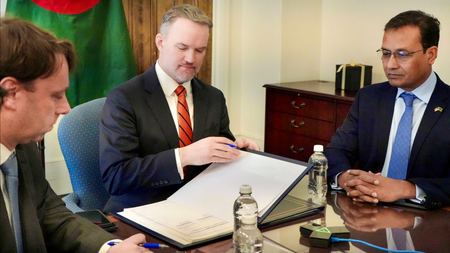
The report stated that Bangladesh’s interim government signed the agreement on February 9, shortly before the end of its tenure, to secure partial tariff relief. However, it noted that the deal extends beyond conventional trade concessions and establishes a framework linking Bangladesh’s defence, energy, trade, and digital infrastructure more closely with the United States.
According to the analysis, certain provisions in the agreement could strain Bangladesh’s growing ties with China, which has expanded its presence in the country through trade, infrastructure projects, and defence cooperation following the fall of the Awami League government.
The report highlighted clauses requiring Bangladesh to increase procurement of US military equipment while restricting purchases from “certain countries,” a term it described as an indirect reference to Chinese suppliers. It also noted that under Article 4.3, if Bangladesh signs a free trade or preferential agreement with a “non-market country,” a US regulatory term often applied to China and Russia, Washington could terminate the agreement and reimpose tariffs.
The United States has also pledged to assist Bangladesh in strengthening defence trade cooperation, the report added.
Citing policy expert Mustafizur Rahman, a distinguished fellow at the Centre for Policy Dialogue (CPD), the report described the agreement as being “unjustly imposed” and an example of the “weaponisation of trade.” It also questioned why the interim government led by Muhammad Yunus rushed to sign a deal that the incoming elected government would have to implement, with general elections scheduled for Thursday.
The report further noted that Bangladesh would be required to offer zero duty on several US products and gradually reduce tariffs on others over five to ten years, beginning with a 50 per cent reduction once the agreement comes into effect. Experts warned that these commitments could have significant implications for government revenue.
Selim Raihan, Executive Director of the South Asian Network on Economic Modeling, reportedly described the agreement as heavily skewed, stating that Bangladesh faces far more obligations than the United States, raising concerns over whether the limited tariff benefits justify the commitments.
The agreement also includes large-scale commercial purchases. State-run Biman Bangladesh Airlines is expected to buy 14 Boeing aircraft, potentially reducing reliance on European manufacturer Airbus. Additionally, Bangladesh has committed to importing at least $3.5 billion worth of US agricultural products, including wheat and soybeans.
The US-Bangladesh joint statement also refers to upcoming commercial deals in agriculture, energy, and technology sectors. This includes plans to purchase agricultural commodities such as wheat, soy, cotton, and corn, along with energy products estimated to be worth $15 billion over a 15-year period.
The report concluded that these purchase commitments would facilitate smoother entry of US agricultural goods into Bangladesh by reducing procedural barriers that previously affected imports.
With inputs from IANS



© Copyright
Reporter Post.All Rights Reserved |
Powered by: Aptilogic Software |
 |
Page rendered in 0.0147 seconds.
|
Page rendered in 0.0147 seconds.