Sat, October 24, 2026
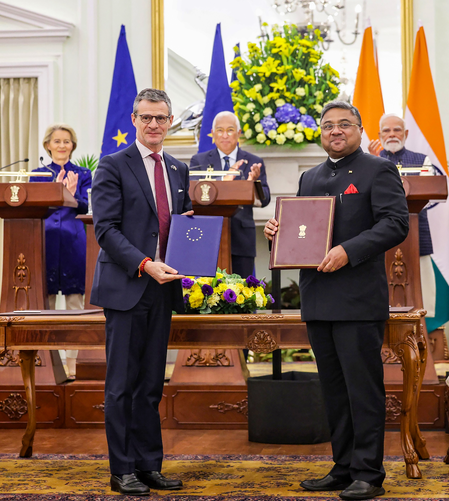
New Delhi: Even as the India–European Union Free Trade Agreement is being hailed as the “mother of all trade deals,” Khalistani groups appear deeply unsettled by the development, fearing that closer ties between India and the EU will significantly strengthen New Delhi’s ability to act against them.
Khalistani outfits, which have established bases in countries such as Canada, Germany and the United Kingdom, believe that enhanced cooperation between India and the EU will weaken their activities. Groups such as Babbar Khalsa International (BKI) and Sikhs for Justice (SFJ) have long benefited from what they perceive as a soft approach by successive European governments, often citing free speech to justify their operations and propaganda against India.
India has repeatedly conveyed to these countries that such organisations are dangerous and are officially designated as terrorist groups under Indian law. The anxiety among these elements became evident in a statement by SFJ chief Gurpatwant Singh Pannun, who claimed that what the EU is celebrating as a free trade deal would result in a “Free Transnational Terrorism Agreement.”
According to Intelligence Bureau officials, while the statements reflect panic triggered by the deal, they are also intended to incite hatred and violence against Indians living in European countries by provoking sympathisers of the Khalistani cause.
Experts note that countries such as the UK and Canada have already begun acting against these groups after India shared substantial evidence highlighting their terrorist activities. The India-EU agreement further complicates matters for Khalistani outfits, as both sides have committed to closer cooperation on terrorism-related issues.
Officials said Pannun and his associates have made repeated attempts to gain traction for what was projected as a mass movement against India, but remains a fringe activity. By targeting both India and the EU, Khalistani groups are attempting to internationalise the issue, which officials described as little more than a publicity stunt.
Following the signing of the agreement, Prime Minister Narendra Modi stated that the India-EU security and defence partnership would deepen cooperation in counter-terrorism, maritime security and cyber security. A joint statement said both sides welcomed the EU-India Security and Defence Partnership — the first comprehensive defence and security framework between them — aimed at strengthening collaboration in maritime security, defence technology, cyber and hybrid threats, space, and counter-terrorism.
The leaders also welcomed the launch of negotiations on a Security of Information Agreement to enable the exchange of classified information and further enhance cooperation in security and defence matters.
Counter-terrorism experts say the heightened focus on security cooperation has naturally alarmed Khalistani groups. After expressing apprehension, Pannun returned to issuing threats, warning of attacks, including targeting the Beating Retreat Ceremony on January 29, and repeating claims of alleged oppression of the Sikh community.
Experts dismiss such claims as false, noting that if Sikhs were genuinely under threat in India, the movement would have gained widespread support in Punjab, which has not happened.
Meanwhile, officials say Pakistan’s ISI continues efforts to revive the Khalistan movement in Punjab, including attempts to drop arms and ammunition using drones. Drug trafficking routes are also being exploited to raise funds, both for Khalistani elements and terror groups operating in Jammu and Kashmir.
With inputs from IANS


© Copyright
Reporter Post.All Rights Reserved |
Powered by: Aptilogic Software |
 |
Page rendered in 0.0082 seconds.
|
Page rendered in 0.0082 seconds.