Mon, October 12, 2026

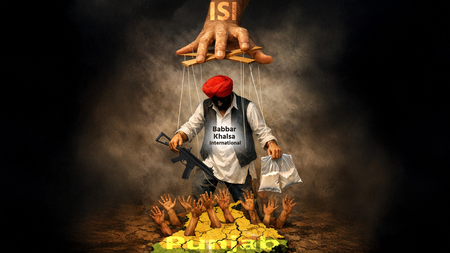
New Delhi: Fresh intelligence inputs indicate that Pakistan-based handlers are planning to push large consignments of drugs, arms and ammunition into Punjab as part of a renewed strategy to revive the Khalistan movement, with the Babbar Khalsa International (BKI) tasked to spearhead the operation.
Sources said the plan was finalised at a recent meeting held in Lahore, where it was decided that Punjab would be flooded with narcotics and weapons. While this is aimed at strengthening the Khalistan movement in the state, a portion of the contraband is also intended to be routed onward to Jammu and Kashmir.
Intelligence Bureau officials said the ISI is facing pressure from Khalistani elements operating from Canada and other countries, as efforts to revive the movement in Punjab have failed to gain momentum. Central agencies, along with the Punjab Police, have so far been successful in keeping these elements at bay.
Officials noted that the youth in Punjab have shown little inclination towards the idea of a separate Khalistan. Attempts to radicalise them have largely failed, with elders in the state openly warning against the harmful consequences of the movement. As ideological appeal has not worked, BKI is now seeking to use money and drugs as tools for recruitment.
The meeting, held at Lahore’s Gulbarg locality, focused on making a renewed push in Punjab by exploiting the state’s drug problem. Intelligence agencies have learnt that BKI has stockpiled large quantities of drugs, arms and ammunition at warehouses provided by the ISI in Lahore, Islamabad and Faizabad. Significant consignments have reportedly arrived at these locations in recent months, with efforts underway to move them into India.
While Khalistani groups have struggled to gain traction within Punjab, their international campaigns have seen some success. Organisations such as Sikhs for Justice (SFJ) have conducted so-called referendums abroad and used social media platforms to spread anti-India propaganda. These overseas players are now questioning the ISI over the lack of impact of operations inside India.
Officials said Pakistan’s intelligence agency has been actively training Khalistani elements to scale up activities, with camps reportedly operational in Attock, Not Lakhpat, Chakwal and Gujranwala. At the Lahore meeting, the ISI reiterated that all Khalistani terror groups should function as a unified entity—a strategy also being pushed for outfits like Lashkar-e-Tayiba and Jaish-e-Mohammad to avoid rivalry and enhance operational impact.
While reviving the Khalistan movement remains the primary objective, agencies have warned that the strategy also targets Jammu and Kashmir. With heightened security along the Line of Control making infiltration difficult, Pakistan is now looking to move drugs and weapons into Punjab in bulk and later transport them by road to Jammu and Kashmir.
In the aftermath of Operation Sindoor, the ISI has reportedly been trying to nurture homegrown terrorists but has faced challenges in funding them. By intensifying activities along the Punjab border, officials said, Pakistan is attempting to simultaneously revive Khalistani networks and finance terrorism in Jammu and Kashmir.
With inputs from IANS



© Copyright
Reporter Post.All Rights Reserved |
Powered by: Aptilogic Software |
 |
Page rendered in 0.0136 seconds.
|
Page rendered in 0.0136 seconds.