Sat, September 12, 2026
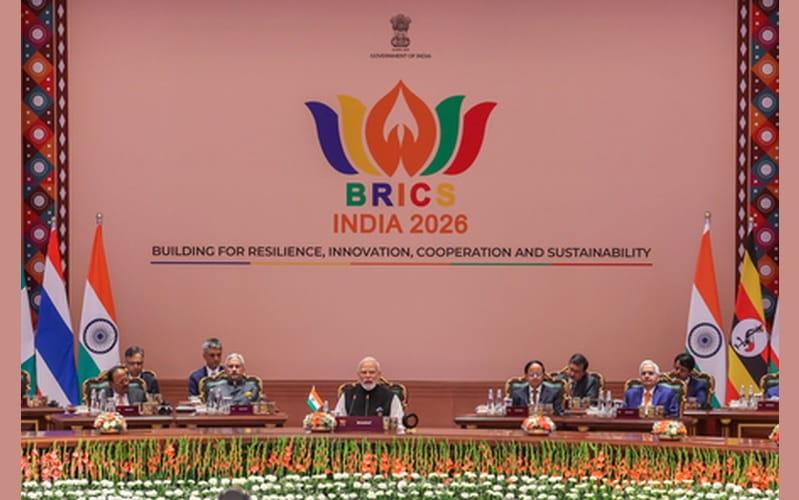
Photo: IANS
Prime Minister Narendra Modi has outlined an ambitious roadmap for the next 20 years of BRICS, calling for the grouping to move beyond being a platform for emerging economies and evolve into a stronger force for reforming the global governance system.
Speaking during India’s BRICS presidency, Modi said the grouping had completed two decades of its journey and had now entered a phase of greater maturity and responsibility. He described the moment as BRICS’ “coming of age” and stressed that its future should be defined not merely by expansion or annual summits, but by its ability to contribute to meaningful changes in the global order.
From a “power pyramid” to a “platform of partnership”
Modi compared the existing global governance architecture to a “pyramid of power”, where decision-making remains concentrated among a relatively small group of countries, while many nations affected by those decisions have limited influence over how they are made.
He said the Global South is often at the forefront of global crises but remains underrepresented in key decision-making institutions.
The Prime Minister called for this “pyramid of privilege” to be transformed into a “platform of partnership” where every country has a voice, every member has a meaningful stake and human development remains at the centre of global policymaking.
As part of this approach, Modi proposed that BRICS members prepare 10 concrete proposals for reforming global governance. These proposals could subsequently be consolidated into a comprehensive Reform Roadmap to be presented at the next BRICS Summit.
Push for reforms from the UN to global financial institutions
Reform of global institutions, greater representation and accountability were identified as key priorities in Modi’s vision for the future of BRICS.
He said reform of the United Nations Security Council could no longer be delayed and called for the reform process to be linked to a clear timeline and measurable outcomes.
Modi also called for reforms in international financial institutions so that voting rights, leadership structures and policy priorities better reflect present-day economic realities.
Countries that have emerged as major contributors to global economic growth, he argued, should also have an appropriate role in shaping decisions within the international financial system.
Stronger continuity within BRICS
The Prime Minister also proposed strengthening BRICS’ internal institutional mechanisms to ensure that the organisation’s initiatives continue to move forward even as the presidency rotates among member countries.
He suggested the creation of a BRICS Continuity and Implementation Mechanism to monitor decisions and ensure continuity from one presidency to the next.
Under the proposal, the existing Troika arrangement could play a greater role in tracking the implementation of decisions, while a secure digital record could be maintained to preserve institutional memory and monitor progress.
Emergency support network for seafarers
Modi also proposed establishing a “Seafarers’ Emergency Support Network” for people working in the maritime sector.
The proposed mechanism could provide assistance to seafarers caught in emergencies, including medical support, communication with family members and evacuation assistance when necessary.
A broader role for BRICS
Modi’s message was that the next two decades of BRICS should not be limited to expanding membership or holding annual meetings. The grouping, he said, should focus on implementing its own decisions while working towards a global governance system based on greater representation, accountability and partnership.
The proposed 20-year vision seeks to position BRICS as a more effective platform for the Global South and as a force capable of contributing to reforms in the institutions that shape global economic and political decision-making.


© Copyright
Reporter Post.All Rights Reserved |
Powered by: Aptilogic Software |
 |
Page rendered in 0.009 seconds.
|
Page rendered in 0.009 seconds.