Mon, September 21, 2026

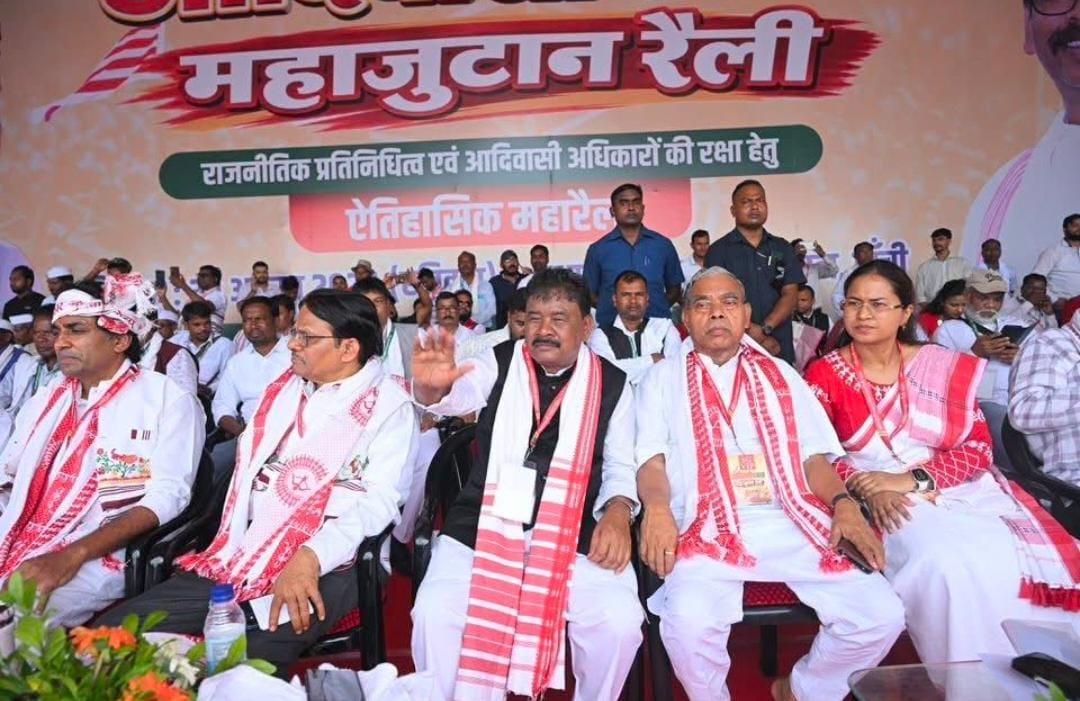
Photo: Reporter Post
Morabadi Maidan in Ranchi witnessed a massive gathering of members of Jharkhand's tribal communities on Sunday, with participants raising strong concerns over the proposed delimitation exercise and its possible impact on tribal political representation.
People from all 24 districts of the state attended the Tribal Maha Jutan, many dressed in traditional attire. The gathering brought together political leaders, social activists and members of tribal organisations, with issues ranging from delimitation and political representation to land rights, displacement and the protection of jal, jungle and zameen.
The message from the stage was clear: any change that could weaken the political representation of tribal communities would not be acceptable.
Among those attending the gathering were Jharkhand Congress president Keshav Mahto, state Congress in-charge K. Raju, Agriculture Minister Shilpi Neha Tirkey, MP Sukhdeo Bhagat and MLAs Wilson Kongadi, Bhushan Bara and Vikas Munda, along with several social workers and community representatives. The crowd at Morabadi Maidan continued to grow from the morning.
‘This is not just about the number of seats’
Congress MP Sukhdeo Bhagat read out a message from Rahul Gandhi during the programme. He said the issue should not be viewed merely as a question of how many seats a particular community may gain or lose.
According to Bhagat, the larger concern is the political voice and representation of tribal communities. He called for protection of reserved constituencies and said delimitation should not become a means of weakening tribal representation.
Land and displacement also at the centre of debate
Former minister Bandhu Tirkey said Jharkhand represents a long history of tribal struggles and sacrifices. He linked the delimitation debate with wider concerns involving tribal land, displacement and the state's mineral resources.
Tirkey said the tribal community would continue to raise its voice on issues affecting its rights and interests and would not retreat from the debate over political and constitutional safeguards.
‘Delimitation could have a long-term impact’
Agriculture Minister Shilpi Neha Tirkey said the implications of delimitation could extend far beyond the next election.
She argued that any change in the distribution of constituencies could have a long-term impact on the political position of tribal communities. Referring to provisions related to the Chotanagpur Tenancy Act, Santhal Pargana Tenancy Act and the Fifth Schedule of the Constitution, she stressed the need to protect existing legal and constitutional safeguards.
Leaders highlight tribal unity and forest rights
Wilson Kongadi called for greater unity among tribal communities and urged people to remain collectively engaged with issues concerning their political and social rights.
Bhushan Bara raised concerns over tribal land and displacement, while Vikas Munda referred to earlier delimitation exercises and stressed the importance of protecting reserved constituencies.
Munda also brought issues related to the Forest Rights Act and the forests of Hasdeo into the discussion, linking them to the broader debate over tribal rights and control over natural resources.
Delimitation becomes a wider political debate
The gathering at Morabadi has brought several long-standing tribal concerns together under the larger debate over delimitation. While political representation remained the central issue, speakers also connected it with land protection, displacement, forest rights and constitutional safeguards.
The event is likely to add momentum to the political discussion in Jharkhand over how future delimitation may affect the representation of tribal communities. The concerns raised at the gathering, however, relate to the potential impact of delimitation, and the actual outcome will depend on the delimitation process and the constitutional and legal framework governing it.



© Copyright
Reporter Post.All Rights Reserved |
Powered by: Aptilogic Software |
 |
Page rendered in 0.0068 seconds.
|
Page rendered in 0.0068 seconds.