Thu, September 24, 2026

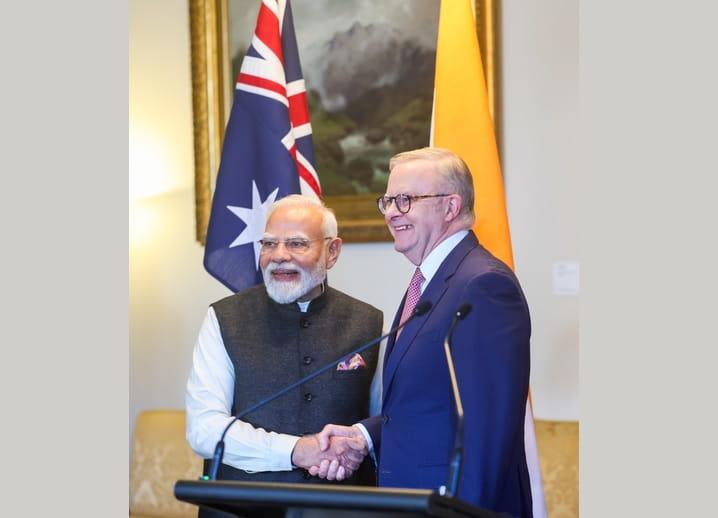
Melbourne: India and Australia on Friday elevated their Comprehensive Strategic Partnership with a series of landmark agreements covering defence, security, energy, critical minerals, cyber technologies and trade following the Annual Leaders' Summit between Prime Minister Narendra Modi and Australian Prime Minister Anthony Albanese.
The two leaders unveiled a Joint Declaration on Defence and Security Cooperation, reaffirming their commitment to a free, open and stable Indo-Pacific. They also agreed to fast-track negotiations for a Comprehensive Economic Cooperation Agreement (CECA) and a bilateral investment treaty to further strengthen economic ties.
Welcoming Prime Minister Modi to Melbourne, Albanese described India as one of Australia's closest partners and highlighted the growing importance of bilateral relations.
"Prime Minister Modi, you are a true friend of Australia, and it has been a great honour to host you for our Annual Leaders' Summit today," Albanese said.
He noted that the partnership had reached new heights over the past six years, with cooperation expanding across multiple sectors through several new agreements.
Among the key announcements was a Joint Maritime Security Collaboration Roadmap aimed at enhancing cooperation in the Indo-Pacific. The two countries also launched a new Australia-India Partnership on Cyber, Critical Technologies and Supply Chains to deepen collaboration in emerging technologies.
In the energy sector, Australia confirmed the signing of an administrative arrangement to operationalise uranium exports to India under the 2015 Australia-India Nuclear Cooperation Agreement. Albanese said the move would support India's clean energy goals while creating new opportunities for Australia's resources industry.
The Australian Prime Minister also announced continued cooperation on critical minerals, support for India's Gaganyaan human spaceflight mission through a temporary space-tracking facility on the Cocos (Keeling) Islands, and progress on cultural repatriation initiatives.
Expressing gratitude for the warm welcome, Prime Minister Modi credited Albanese's leadership for taking India-Australia relations to a new level.
He said the Comprehensive Strategic Partnership had witnessed unprecedented progress in recent years, particularly after the Economic Cooperation and Trade Agreement signed in 2022, which significantly boosted bilateral trade and investment.
Highlighting the decision to accelerate negotiations on CECA, Modi said both countries were committed to achieving a balanced, ambitious and mutually beneficial agreement.
The Prime Minister also described the nuclear energy pact as an important milestone, saying it would facilitate uranium supplies from Australia to India and strengthen the country's clean energy transition.
On critical minerals and advanced technologies, Modi announced that both nations would work together to establish a critical minerals corridor while expanding cooperation through the newly launched partnership on advanced cyber technologies and resilient supply chains.
Reaffirming the shared commitment to regional stability, Modi said the new defence declaration and maritime security roadmap would further strengthen coordination between the two countries' armed forces and enhance efforts to maintain peace and security in the Indo-Pacific.
The two leaders also reiterated their united stand against terrorism. Modi stressed that terrorism remains a global challenge requiring collective action and said India and Australia's commitment to combating it remains unwavering.
Ending his remarks on a lighter note in Melbourne, often regarded as Australia's sporting capital, Modi drew a cricket analogy to describe the relationship between the two nations.
"The agenda is focused like a one-day match, decisions are quick like a T20 game, and our partnership is long-term and enduring like a Test match," he said.
The summit marked another significant step in expanding cooperation between India and Australia across defence, trade, energy, technology and people-to-people ties, reinforcing their shared vision of a secure, prosperous and rules-based Indo-Pacific region.
With inputs from IANS




© Copyright
Reporter Post.All Rights Reserved |
Powered by: Aptilogic Software |
 |
Page rendered in 0.0092 seconds.
|
Page rendered in 0.0092 seconds.