
Thu, September 24, 2026

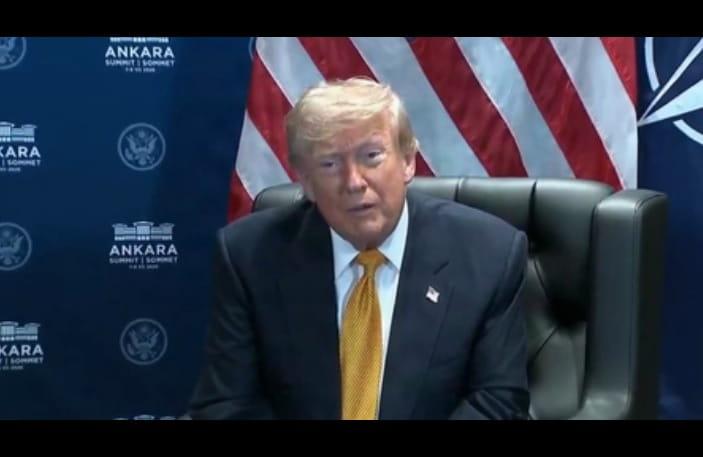
Ankara- US President Donald Trump on Wednesday declared that the ceasefire with Iran was "over", saying he no longer wished to negotiate with Tehran following renewed tensions between the two countries.
Speaking to reporters on the sidelines of the NATO Summit in Ankara, Trump launched a scathing attack on Iran's leadership, calling them "liars" and saying further negotiations would be a "waste of time".
Referring to the stalled peace efforts, Trump said he no longer believed diplomacy with Iran would produce results. While he said US negotiators could continue discussions if they wished, he made it clear that he considered the ceasefire effectively finished.
Trump also accused the Iranian government of violently suppressing anti-government protests and claimed thousands of protesters had been killed, alleging that the issue had received little international media attention.
His remarks came hours after the United States carried out a fresh wave of military strikes against Iran, targeting more than 80 locations in response to what Washington described as recent Iranian attacks on commercial vessels passing through the Strait of Hormuz.
According to the United States Central Command (CENTCOM), the operation used precision-guided munitions to strike Iranian air defence systems, command and control networks, coastal radar sites, anti-ship missile capabilities and more than 60 boats operated by the Islamic Revolutionary Guard Corps (IRGC) in and around the Strait of Hormuz.
CENTCOM said the strikes were intended to reduce Iran's ability to threaten international maritime trade after what it described as attacks on three commercial vessels transiting the strategic waterway.
The US military alleged that the targeted vessels included the Marshall Islands-flagged M/T Al Rekayyat, the Saudi Arabia-flagged M/T Wedyan and the Liberian-flagged M/T Cyprus Prosperity. Washington described the incidents as a violation of the ceasefire and a threat to freedom of navigation.
The Strait of Hormuz is one of the world's most important maritime chokepoints, with a significant share of global oil exports and commercial shipping passing through it. Any disruption in the region can have far-reaching consequences for international trade and energy markets.
With inputs from IANS



© Copyright
Reporter Post.All Rights Reserved |
Powered by: Aptilogic Software |
 |
Page rendered in 0.0082 seconds.
|
Page rendered in 0.0082 seconds.