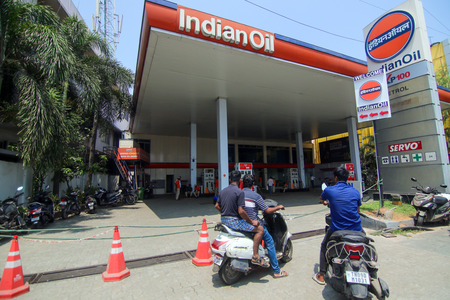
Thu, April 02, 2026


New Delhi — The Indian rupee recorded its sharpest single-day rise in more than a decade on Thursday after the Reserve Bank of India stepped up measures to curb currency speculation, including extending restrictions to offshore derivatives markets.
The rupee strengthened by as much as 1.7 per cent to 93.25 against the US dollar — its biggest jump since 2013 — when trading resumed after a three-day holiday break. The rally came even as most Asian currencies weakened amid rising geopolitical tensions following remarks by US President Donald Trump on West Asia.
Global crude prices moved higher during the session, with Brent crude futures climbing to $106.47 per barrel, up 5.24 per cent, while West Texas Intermediate futures rose 4.5 per cent to $104.64.
Asian equity markets remained under pressure, with key indices such as the Nikkei, Hang Seng, and KOSPI falling by as much as 3 per cent. Domestic benchmarks — Sensex and Nifty — also opened lower, slipping up to 2 per cent in early trade.
Currency markets had remained shut since Monday due to holidays, including Mahavir Jayanti on March 31 and the start of the new financial year on April 1, and will remain closed again on Good Friday on April 3.
To rein in speculative activity, the RBI barred banks from offering rupee non-deliverable forwards to both resident and non-resident clients and restricted companies from rebooking cancelled forward contracts. Earlier, the central bank capped banks’ net open rupee positions at $100 million and prohibited foreign exchange derivative deals with related parties.
Analysts noted that India’s foreign exchange reserves — exceeding $700 billion — provide a strong buffer, enabling the RBI to intervene if needed and helping deter speculative pressure on the currency.
With inputs from IANS




| 14-09-2018 | ||||||
| Sl No. | Parameters | Actual Data(µg/m3) | Standard Limit(µg/m3) |
|---|---|---|---|
| 1 | PM 10 | 64 | 100 |
| 2 | PM 2.5 | 33 | 60 |
| 3 | SO2 | 55.3 | 80 |
| 4 | NO2 | 58.2 | 80 |
| 14-09-2018 | ||||||
| Station | Temperature(degree centigrade) | Rainfall(mm) | Relative humidity(%) | |||
|---|---|---|---|---|---|---|
| Max | Min | Past 24 hrs. | Since 1st March, 2018 | Max | Min | |
| Ranchi | 31.0 | 22.5 | 000.0 | 1010.1 | 95 | 66 |
| Jamshedpur | 34.1 | 26.2 | 000.0 | 1252.8 | 87 | 58 |
| Bokaro | 33.5 | 24.6 | 015.2 | 824.0 | 92 | 79 |
| Daltonganj | 32.6 | 24.9 | 004.2 | 960.9 | 95 | 67 |
© Copyright
Reporter Post.All Rights Reserved |
Powered by: Aptilogic Software |
 |
Page rendered in 0.0163 seconds.
|
Page rendered in 0.0163 seconds.