Sun, December 21, 2025

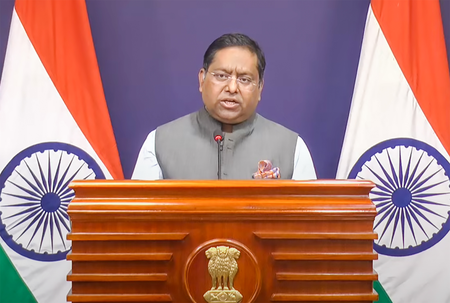
New Delhi: President Droupadi Murmu has given her assent to the Viksit Bharat—Guarantee for Rozgar and Ajeevika Mission (Gramin) (VB–G RAM G) Bill, 2025, marking a major milestone in the transformation of India’s rural employment policy, an official from the Ministry of Rural Development said on Sunday.
With the President’s assent, the VB–G RAM G Act, 2025, comes into force, significantly strengthening the statutory framework for rural wage employment. The new law enhances the employment guarantee to 125 days per financial year for rural households and aims to promote empowerment, inclusive growth, convergence of development initiatives and saturation-based service delivery, thereby reinforcing the foundation for a prosperous, resilient and self-reliant Rural Bharat.
Parliament had earlier passed the Viksit Bharat—Guarantee for Rozgar and Ajeevika Mission (Gramin) Bill, 2025, ushering in a decisive reform in India’s rural employment and development architecture. The Act replaces the Mahatma Gandhi National Rural Employment Guarantee Act (MGNREGA), 2005, with a modernised statutory framework aligned with the national vision of Viksit Bharat @2047.
According to the ministry, the Act is anchored in the core principles of empowerment, growth, convergence and saturation. It seeks to transform rural employment from a standalone welfare measure into an integrated instrument of development. By strengthening income security for rural households, modernising governance and accountability mechanisms, and linking wage employment to the creation of durable and productive rural assets, the law aims to lay the groundwork for a more resilient and prosperous rural economy.
One of the key features of the Act is the enhanced statutory employment guarantee. Under Section 5(1), the law provides a minimum guarantee of 125 days of wage employment per rural household in each financial year to households whose adult members volunteer to undertake unskilled manual work. This increase from the earlier 100-day entitlement is expected to significantly improve livelihood security, ensure greater predictability of work and enhance income stability for rural families.
The Act also introduces a balanced provision to address both agricultural productivity and rural labour welfare. To ensure adequate availability of agricultural labour during peak sowing and harvesting periods, states are empowered under Section 6 to notify an aggregated pause period of up to 60 days in a financial year. The ministry clarified that the full 125-day employment guarantee remains unchanged and will be provided during the remaining period, ensuring a calibrated balance between farm requirements and worker security.
Technology has been positioned as an enabling tool rather than a barrier under the new law. Sections 23 and 24 provide for technology-enabled transparency through measures such as biometric authentication, geo-tagging and real-time dashboards. At the same time, Section 20 strengthens the role of Gram Sabhas in conducting social audits, ensuring community oversight, transparency and inclusiveness in implementation.
The Act also removes earlier dis-entitlement provisions and restores the unemployment allowance as a meaningful statutory safeguard. If employment is not provided within the stipulated timeframe, the unemployment allowance becomes payable after 15 days, reinforcing accountability and protecting the rights of rural workers.
With inputs from IANS




| 14-09-2018 | ||||||
| Sl No. | Parameters | Actual Data(µg/m3) | Standard Limit(µg/m3) |
|---|---|---|---|
| 1 | PM 10 | 64 | 100 |
| 2 | PM 2.5 | 33 | 60 |
| 3 | SO2 | 55.3 | 80 |
| 4 | NO2 | 58.2 | 80 |
| 14-09-2018 | ||||||
| Station | Temperature(degree centigrade) | Rainfall(mm) | Relative humidity(%) | |||
|---|---|---|---|---|---|---|
| Max | Min | Past 24 hrs. | Since 1st March, 2018 | Max | Min | |
| Ranchi | 31.0 | 22.5 | 000.0 | 1010.1 | 95 | 66 |
| Jamshedpur | 34.1 | 26.2 | 000.0 | 1252.8 | 87 | 58 |
| Bokaro | 33.5 | 24.6 | 015.2 | 824.0 | 92 | 79 |
| Daltonganj | 32.6 | 24.9 | 004.2 | 960.9 | 95 | 67 |
© Copyright
Reporter Post.All Rights Reserved |
Powered by: Aptilogic Software |
 |
Page rendered in 0.0202 seconds.
|
Page rendered in 0.0202 seconds.