Sun, December 21, 2025

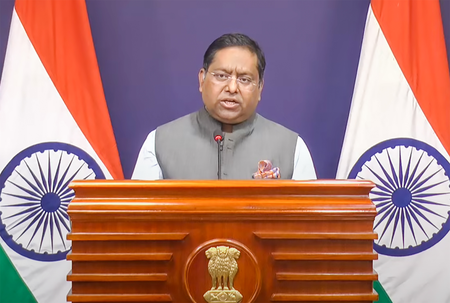
New Delhi: India on Sunday strongly criticised what it described as “misleading propaganda” in sections of the Bangladeshi media regarding a protest held outside the Bangladesh High Commission in New Delhi, while reiterating its firm commitment to ensuring the safety and security of all foreign missions and diplomatic posts on its territory.
The clarification came a day after a small group of protesters gathered outside the Bangladesh High Commission, demanding accountability for the recent rise in violence against Hindu minorities in Bangladesh. New Delhi stated that the demonstration was brief and peaceful, and was dispersed by police within minutes.
Responding to media queries, the Ministry of External Affairs (MEA) said that around 20–25 youths assembled outside the mission on December 20, raising slogans to protest the killing of Dipu Chandra Das in Bangladesh’s Mymensingh district and calling for the protection of minorities in the neighbouring country.
“We have noted misleading propaganda in sections of the Bangladesh media on the incident. The fact is that about 20–25 youth gathered in front of the Bangladesh High Commission in New Delhi on 20 December and raised slogans in protest against the horrendous killing of Dipu Chandra Das in Mymensingh, while also calling for the protection of all minorities in Bangladesh,” the MEA said in a statement.
The ministry emphasised that there was no attempt to breach security or create any law-and-order situation. “There was no attempt to breach the fence or create a security situation at any time. The police stationed at the spot dispersed the group after a few minutes. Visual evidence of these events is available publicly for all to see. India is committed to ensuring the safety of foreign Missions/Posts in its territory in accordance with the Vienna Convention,” it added.
The MEA also said that India is closely monitoring the evolving situation in Bangladesh and remains in regular contact with Bangladeshi authorities. It has conveyed strong concerns over the recent attacks on minorities and urged that those responsible for the killing of Dipu Chandra Das be brought to justice.
“India continues to keep a close watch on the evolving situation in Bangladesh. Our officials remain in touch with the Bangladesh authorities and have conveyed to them our strong concerns at the attacks on minorities. We have also urged that the perpetrators of the barbaric killing of Das be brought to justice,” the statement said.
On December 18, Dipu Chandra Das, a 30-year-old Hindu worker, was killed in a mob lynching at the Pioneer Knit Composite Factory in Bhaluka Upazila of Mymensingh district over allegations of insulting Islam. Local media reported that his body was later set on fire, triggering widespread tension and leading to a temporary halt of traffic on the Dhaka–Mymensingh highway.
Das, a resident of Tarakanda upazila, was allegedly accused of making derogatory remarks about Islam and Prophet Muhammad during an event at the factory marking World Arabic Language Day. The allegations reportedly spread rapidly, fuelling anger among workers and local residents. He was subsequently beaten by a mob and died on the spot.
Reports further indicated that after his death, the crowd tied the body to a tree, assaulted it while raising slogans, and set it ablaze. The body was later taken to the Dhaka–Mymensingh highway and burned again, causing panic and disruption in the area.
Confirming the incident, Bhaluka Upazila Executive Officer Md. Firoz Hossain said a person had been killed following allegations of insulting the Prophet, and that the body was taken into police custody. However, officials later stated that no evidence had been found to support claims that Das made any offensive remarks, and neither local residents nor factory workers corroborated the allegations.
Bangladesh has witnessed a surge in violence against minorities, including Hindus, under the Yunus-led interim government, drawing strong reactions and concern from people and human rights organisations worldwide.
With inputs from IANS




| 14-09-2018 | ||||||
| Sl No. | Parameters | Actual Data(µg/m3) | Standard Limit(µg/m3) |
|---|---|---|---|
| 1 | PM 10 | 64 | 100 |
| 2 | PM 2.5 | 33 | 60 |
| 3 | SO2 | 55.3 | 80 |
| 4 | NO2 | 58.2 | 80 |
| 14-09-2018 | ||||||
| Station | Temperature(degree centigrade) | Rainfall(mm) | Relative humidity(%) | |||
|---|---|---|---|---|---|---|
| Max | Min | Past 24 hrs. | Since 1st March, 2018 | Max | Min | |
| Ranchi | 31.0 | 22.5 | 000.0 | 1010.1 | 95 | 66 |
| Jamshedpur | 34.1 | 26.2 | 000.0 | 1252.8 | 87 | 58 |
| Bokaro | 33.5 | 24.6 | 015.2 | 824.0 | 92 | 79 |
| Daltonganj | 32.6 | 24.9 | 004.2 | 960.9 | 95 | 67 |
© Copyright
Reporter Post.All Rights Reserved |
Powered by: Aptilogic Software |
 |
Page rendered in 0.0149 seconds.
|
Page rendered in 0.0149 seconds.