Sun, December 28, 2025

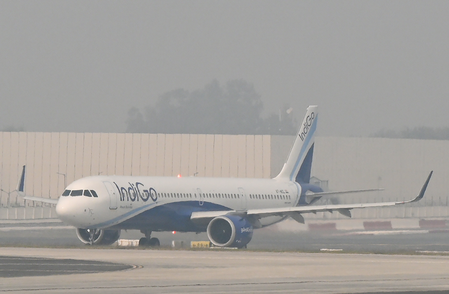
New Delhi— Delhi Airport on Friday announced that **all IndiGo domestic flights departing from the capital have been cancelled until midnight** amid one of the airline’s most serious operational breakdowns in recent years.
In a statement posted on X, the airport said:
**“IndiGo domestic flights departing from Delhi Airport on 5th December 2025 are cancelled till midnight (23:59 hours). Operations for all other carriers remain as scheduled.”**
The airport added that ground teams were coordinating with IndiGo to reduce passenger inconvenience, urging travellers to check real-time updates on its official website.
### **Massive Disruptions Across Network**
The cancellations follow a day of chaos during which **over 500 flights** were cancelled on Thursday, with several more delayed. IndiGo had already recorded **1,232 cancellations in November**, signalling deep operational strain.
Earlier, the airport issued an advisory asking passengers to verify flight statuses before travelling.
### **Government Steps In**
Amid escalating disruption, Civil Aviation Minister **Kinjarapu Rammohan Naidu** convened an emergency meeting with IndiGo leadership. The Ministry of Civil Aviation said it is maintaining “heightened oversight,” while the **AAI** has been directed to support stranded passengers.
The **DGCA** is also monitoring airfares amid fears of sudden spikes due to reduced flight capacity.
### **Why Is IndiGo Struggling?**
According to DGCA sources, IndiGo admitted that disruptions stem from:
* Challenges complying with **Phase II** of the revised **Flight Duty Time Limitations (FDTL)** meant to reduce pilot fatigue
* **Crew shortages** arising from miscalculations in manpower planning
* Seasonal **winter operational constraints**
The airline said disruptions may continue for **2–3 days**, and from **December 8** it will cut flight frequency to stabilise operations. IndiGo has also sought **temporary relaxation of FDTL norms for A320 aircraft until February 10, 2026**, promising full operational recovery by then.
---With inputs from IANS




| 14-09-2018 | ||||||
| Sl No. | Parameters | Actual Data(µg/m3) | Standard Limit(µg/m3) |
|---|---|---|---|
| 1 | PM 10 | 64 | 100 |
| 2 | PM 2.5 | 33 | 60 |
| 3 | SO2 | 55.3 | 80 |
| 4 | NO2 | 58.2 | 80 |
| 14-09-2018 | ||||||
| Station | Temperature(degree centigrade) | Rainfall(mm) | Relative humidity(%) | |||
|---|---|---|---|---|---|---|
| Max | Min | Past 24 hrs. | Since 1st March, 2018 | Max | Min | |
| Ranchi | 31.0 | 22.5 | 000.0 | 1010.1 | 95 | 66 |
| Jamshedpur | 34.1 | 26.2 | 000.0 | 1252.8 | 87 | 58 |
| Bokaro | 33.5 | 24.6 | 015.2 | 824.0 | 92 | 79 |
| Daltonganj | 32.6 | 24.9 | 004.2 | 960.9 | 95 | 67 |
© Copyright
Reporter Post.All Rights Reserved |
Powered by: Aptilogic Software |
 |
Page rendered in 0.0488 seconds.
|
Page rendered in 0.0488 seconds.