Sun, December 28, 2025

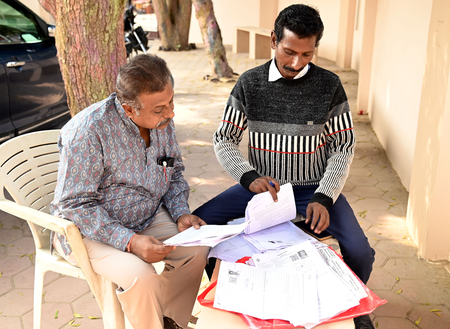
New Delhi- The Supreme Court on Thursday issued a set of directives aimed at reducing the workload of Booth Level Officers (BLOs) participating in the Election Commission’s ongoing Special Intensive Revision (SIR) exercise across several states, following disturbing reports of deaths and FIRs filed against field staff.
A bench comprising Chief Justice of India (CJI) Surya Kant and Justice Joymalya Bagchi noted that employees deputed by state governments and State Election Commissions (SECs) are duty-bound to participate in such exercises. However, the Court emphasised that state governments must step in whenever BLOs experience hardships.
The Bench recommended that state governments provide additional personnel to the Election Commission of India (ECI), allowing for a proportional reduction in working hours.
It further directed that any employee seeking exemption for specific reasons should have their request examined individually. “The competent authority shall consider such requests case-by-case and replace such persons with another employee. However, it shall not be construed as permission to withdraw employees without providing substitutes,” the Court clarified.
The Court was hearing a plea filed by Tamilaga Vettri Kazhagam (TVK), led by actor-politician Vijay, seeking protection for BLOs from coercive action under Section 32 of the Representation of the People Act. The petition highlighted 35–40 deaths of BLOs nationwide, allegedly caused by extreme work pressure during the SIR process.
Senior advocate Gopal Sankaranarayanan, representing TVK, said that FIRs under Section 32 had been filed in Uttar Pradesh, while Anganwadi workers and teachers were being assigned SIR duties before and after their regular working hours. He cited a tragic case where a young man, denied leave for his own wedding, died by suicide due to stress.
The application, filed through advocate Yash S. Vijay, provided multiple accounts of suicides and cardiac-related deaths in Tamil Nadu, Kerala, West Bengal, Gujarat, Rajasthan, Madhya Pradesh, and Uttar Pradesh. The petition argued that the current SIR timeline is “wholly unreasonable” and sought an extension until March 2026.
Sankaranarayanan added that Section 32 proceedings can only be initiated by the ECI, stressing the “chilling effect” such actions have on already overburdened BLOs.
Senior advocate Kapil Sibal echoed concerns about the “harsh reality” faced by BLOs and questioned the urgency behind providing only 30 days for enumeration in states like Uttar Pradesh, which faces elections in 2027.
Countering the petition, senior advocate Maninder Singh, appearing for the ECI, said the plea was “baseless” and claimed that in many cases, BLOs were unwilling to perform their assigned tasks, prompting the Commission to file complaints.
The CJI-led bench remarked that while the ECI requires cooperation from state governments to complete the revision process, state authorities cannot avoid their responsibilities.
The Court added that employees facing legitimate hardships—such as illness or pregnancy—may be replaced by the state government.
Regarding reported BLO deaths, the Supreme Court stated that claims for ex gratia compensation may be considered separately at a later stage.
With inputs from IANS




| 14-09-2018 | ||||||
| Sl No. | Parameters | Actual Data(µg/m3) | Standard Limit(µg/m3) |
|---|---|---|---|
| 1 | PM 10 | 64 | 100 |
| 2 | PM 2.5 | 33 | 60 |
| 3 | SO2 | 55.3 | 80 |
| 4 | NO2 | 58.2 | 80 |
| 14-09-2018 | ||||||
| Station | Temperature(degree centigrade) | Rainfall(mm) | Relative humidity(%) | |||
|---|---|---|---|---|---|---|
| Max | Min | Past 24 hrs. | Since 1st March, 2018 | Max | Min | |
| Ranchi | 31.0 | 22.5 | 000.0 | 1010.1 | 95 | 66 |
| Jamshedpur | 34.1 | 26.2 | 000.0 | 1252.8 | 87 | 58 |
| Bokaro | 33.5 | 24.6 | 015.2 | 824.0 | 92 | 79 |
| Daltonganj | 32.6 | 24.9 | 004.2 | 960.9 | 95 | 67 |
© Copyright
Reporter Post.All Rights Reserved |
Powered by: Aptilogic Software |
 |
Page rendered in 0.0557 seconds.
|
Page rendered in 0.0557 seconds.