Sun, December 28, 2025

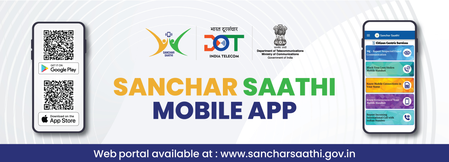
New Delhi: The government on Wednesday announced that it has withdrawn the requirement for mobile manufacturers to pre-install the Sanchar Saathi app on all smartphones, citing a rapid rise in voluntary user registrations and increasing public confidence in the platform.
The Ministry of Communications said the app — developed to safeguard citizens against cyber fraud and telecom-related crimes — has seen strong organic uptake, making compulsory installation unnecessary.
According to the ministry, 1.4 crore users have already downloaded Sanchar Saathi, enabling the reporting of nearly 2,000 fraud cases daily.
It highlighted that six lakh people registered to download the app in the last 24 hours alone, marking a tenfold jump in adoption.
The government noted that the pre-installation mandate was introduced to ensure that less-aware users also had access to cybersecurity tools. But with the recent surge in voluntary usage, the rule has now been revoked.
“Given Sanchar Saathi’s increasing acceptance, the Government has decided not to make the pre-installation mandatory for mobile manufacturers,” the Centre said.
The ministry reiterated that the app is secure, includes no surveillance features, and is designed solely to help citizens report cyber fraud and stay protected. It added that users are free to delete the app at any time, and that the initiative strengthens “jan bhagidari” by encouraging public participation in combating cybercrime.
The decision came shortly after Communications Minister Jyotiraditya Scindia rejected allegations of snooping in Parliament. Speaking in the Lok Sabha during Question Hour, he stressed that the app cannot monitor users and remains inactive unless someone voluntarily registers.
“Snooping is neither possible nor will it happen with the Sanchar Saathi safety app,” Scindia said, adding in Hindi, “Sanchar Saathi app se na snooping sambhav hai, na snooping hoga.”
He emphasised that the app is intended only to help users protect themselves from digital threats such as fake mobile connections, fraudulent calls, and lost or stolen phones.
With inputs from IANS




| 14-09-2018 | ||||||
| Sl No. | Parameters | Actual Data(µg/m3) | Standard Limit(µg/m3) |
|---|---|---|---|
| 1 | PM 10 | 64 | 100 |
| 2 | PM 2.5 | 33 | 60 |
| 3 | SO2 | 55.3 | 80 |
| 4 | NO2 | 58.2 | 80 |
| 14-09-2018 | ||||||
| Station | Temperature(degree centigrade) | Rainfall(mm) | Relative humidity(%) | |||
|---|---|---|---|---|---|---|
| Max | Min | Past 24 hrs. | Since 1st March, 2018 | Max | Min | |
| Ranchi | 31.0 | 22.5 | 000.0 | 1010.1 | 95 | 66 |
| Jamshedpur | 34.1 | 26.2 | 000.0 | 1252.8 | 87 | 58 |
| Bokaro | 33.5 | 24.6 | 015.2 | 824.0 | 92 | 79 |
| Daltonganj | 32.6 | 24.9 | 004.2 | 960.9 | 95 | 67 |
© Copyright
Reporter Post.All Rights Reserved |
Powered by: Aptilogic Software |
 |
Page rendered in 0.0439 seconds.
|
Page rendered in 0.0439 seconds.