Wed, October 14, 2026

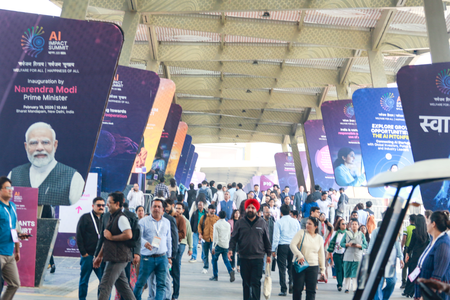
New Delhi: At the ‘AI Impact Summit 2026’, leading industry executives discussed the growing influence of AI agents on traditional software-as-a-service (SaaS) models, cautioning against exaggerated claims of immediate disruption.
Arundhati Bhattacharya, Chairperson and CEO of Salesforce India, noted that market narratives often overstate change. She emphasised that SaaS extends far beyond rapid application development, requiring deep workflow understanding, identification of customer pain points, and robust frameworks for observability, governance, auditability, and adoption. While operational methods may evolve, she underlined that sustained success will depend on consistently delivering tangible customer value.
K. Krithivasan, CEO of Tata Consultancy Services, observed that the role of software engineers is transitioning toward high-level architectural design and stringent validation. Although AI offers significant productivity enhancements, he stressed that enterprise-scale implementation demands foundational work, including data rationalisation and application modernisation. Rather than contraction, he foresees expansion — with increased production capacity and the ability to tackle more complex challenges.
Salil Parekh, CEO of Infosys, highlighted a potential $300 billion services opportunity driven by AI, which is making previously unviable solutions economically feasible. He explained that orchestration platforms enable enterprises to combine foundation models with specialised agents to generate measurable business outcomes.
Meanwhile, C Vijayakumar, CEO and Managing Director of HCL Technologies, pointed out that large language and foundational models are not yet optimally suited for many enterprise use cases. He identified a continuing gap between foundational AI capabilities and enterprise-grade performance requirements.
Collectively, the leaders conveyed that while AI agents will significantly reshape business and operating models, they are unlikely to render SaaS obsolete in the near term. The future of enterprise technology will depend on agility, operational readiness, orchestration capabilities, and the sustained ability to address evolving customer needs within increasingly complex digital ecosystems.
— IANS



© Copyright
Reporter Post.All Rights Reserved |
Powered by: Aptilogic Software |
 |
Page rendered in 0.0123 seconds.
|
Page rendered in 0.0123 seconds.