Mon, October 12, 2026

New York- India has emerged as a global leader in artificial intelligence (AI) skills diffusion and AI-related hiring, according to an international ranking that evaluates countries leveraging AI technologies. The achievement comes ahead of the country hosting the International Artificial Intelligence Summit next week.
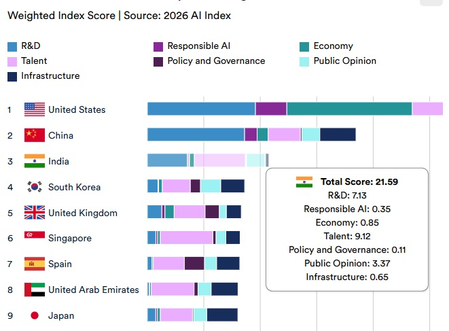
As per the 2026 Global Vibrancy Index (GVI) released by Stanford University’s Institute for Human-Centred AI, India ranks second worldwide in economic competitiveness, trailing only the United States. In the overall index, India stands third globally, behind the United States and China.
In the talent sub-category under the competitiveness criteria, India surpassed the United States, driven by its exceptional performance in AI Skills Penetration and the AI Hiring Ratio. The country also secured second place in several other categories, including AI-related social media conversations net sentiment, AI GitHub projects, and AI GitHub project star ratings. GitHub platforms play a crucial role in collaborative software development and project integration.
The institute credited India’s improved ranking to renewed large-scale initiatives aimed at strengthening its role in the global AI ecosystem. It highlighted that nations worldwide increasingly view artificial intelligence as a strategic national priority.
India has made significant progress since 2017, when it ranked seventh in the first edition of the GVI. The country has now overtaken advanced economies such as Japan, Germany, Singapore, and the United Kingdom, largely due to its growing investments in research and development.
India is scheduled to host the India AI Impact Summit from February 16 to 20 at Bharat Mandapam in New Delhi. Organised by the Ministry of Electronics and Information Technology (MeitY) under the IndiaAI Mission, the summit will bring together policymakers, industry leaders, researchers, startups, students, and global stakeholders.
The summit aims to serve as a major international platform focused on building a future-ready framework for inclusive, responsible, and impactful AI. It intends to move beyond theoretical discussions by delivering practical solutions that support economic growth, social progress, and sustainable AI deployment.
The event will be structured around three key pillars — People, Planet, and Progress. Discussions will cover areas such as employment and skill development, sustainable and energy-efficient AI technologies, and socio-economic advancement. Additionally, seven thematic working groups, jointly led by representatives from developed and developing nations, will present actionable proposals. These include initiatives for AI Commons, trusted AI tools, shared computing infrastructure, and sector-specific AI use-case frameworks.
With inputs from IANS



© Copyright
Reporter Post.All Rights Reserved |
Powered by: Aptilogic Software |
 |
Page rendered in 0.0141 seconds.
|
Page rendered in 0.0141 seconds.