Thu, October 15, 2026

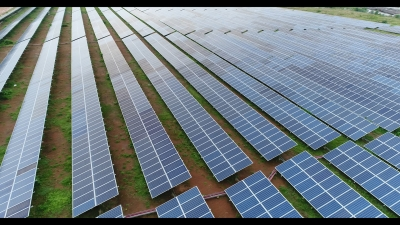
New Delhi: Indian scientists under the Department of Science and Technology (DST) have developed an innovative solar-powered energy storage device capable of capturing and storing energy within a single unit, marking a significant advancement in clean and self-sustaining energy technologies, according to an official statement.
Unlike conventional solar systems that rely on separate units for energy harvesting and storage, this new technology integrates both functions into one device, thereby reducing costs and minimizing energy losses during conversion.
The Ministry of Science and Technology stated that the device, known as a photo-rechargeable supercapacitor, was developed by researchers at the Centre for Nano and Soft Matter Sciences (CeNS), Bengaluru, under DST.
This breakthrough opens the door to efficient, low-cost, and environmentally friendly power solutions for portable, wearable, and off-grid applications. Traditional hybrid systems typically require additional power management electronics to handle voltage and current mismatches between solar harvesters and storage units, increasing system complexity and size—an issue for miniaturised and autonomous devices.
The newly developed device overcomes these challenges through the binder-free use of nickel-cobalt oxide (NiCo?O?) nanowires, uniformly grown on nickel foam using a simple in-situ hydrothermal process.
These nanowires, measuring only a few nanometres in diameter and several micrometres in length, form a highly porous and conductive three-dimensional network. This structure efficiently absorbs sunlight while simultaneously storing electrical charge, enabling the material to function both as a solar energy harvester and a supercapacitor electrode.
During real-world testing, the device delivered a stable output voltage of 1.2 volts and retained 88 per cent of its capacitance even after 1,000 photo-charging cycles. It also demonstrated efficient performance under varying light conditions, ranging from low indoor lighting to strong sunlight.
The sustained performance highlights the durability of the nanowire architecture, which can withstand mechanical and electrochemical stress over long periods. The self-charging system can operate in remote areas without access to the power grid, significantly reducing dependence on fossil fuels and conventional batteries.
— IANS



© Copyright
Reporter Post.All Rights Reserved |
Powered by: Aptilogic Software |
 |
Page rendered in 0.0116 seconds.
|
Page rendered in 0.0116 seconds.