Wed, October 14, 2026

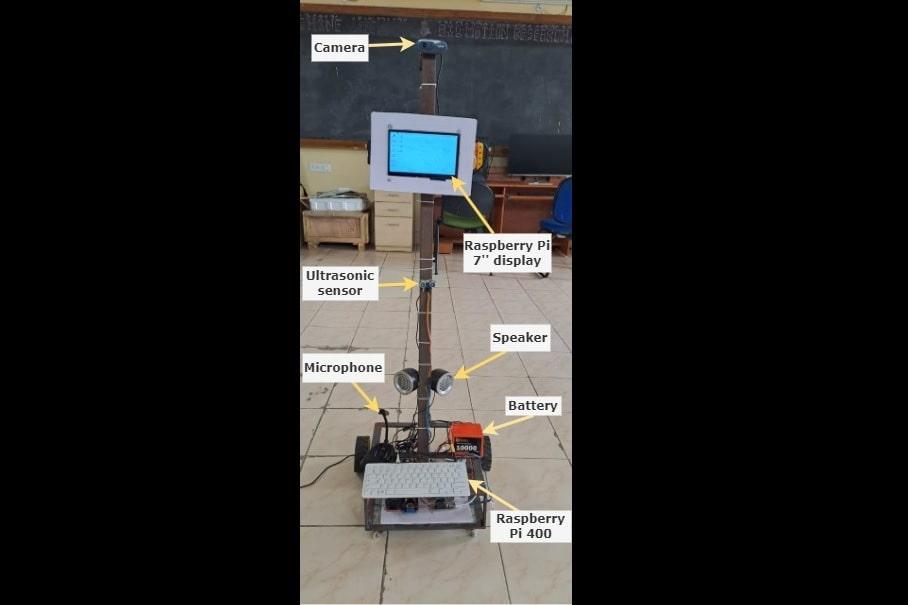
New Delhi — Researchers at the National Institute of Technology (NIT) Rourkela have developed an advanced AI-powered social robot capable of interacting with people in a remarkably human-like manner.
Built using Artificial Intelligence (AI) and Large Language Models (LLMs), the robot can understand everyday language, follow spoken commands, answer questions, and engage in real-time conversations beyond predefined or scripted responses.
A key feature of the system is its emotion recognition capability. It can interpret facial expressions — such as happiness, neutrality, or sadness — and respond accordingly. The robot can greet users, provide instructions, and generate natural-sounding speech in return.
Designed for use in homes, classrooms, offices, hospitals, and community spaces, the robot can also detect simple gestures like waving or raising a hand and react appropriately.
According to Dr. Anup Nandy, Associate Professor in the Department of Computer Science and Engineering at NIT Rourkela, “The indigenously developed robotic system significantly aligns with the Government of India’s Make in India and Atmanirbhar Bharat initiatives. Unlike existing global systems, NIT Rourkela’s social robot integrates gesture, emotion, speech, and LLM-based conversational abilities into a cost-effective platform tailored for Indian environments.”
The Institute has secured a patent for the innovation.
The robot uses a Raspberry Pi system to process inputs such as voice commands or text queries. The integrated LLM analyses the input, interprets the context, and generates a suitable human-like response. Output is delivered through the robot’s speech system using Google Text-to-Speech.
For mobility, the robot is equipped with a wheel-based platform and navigation system, along with a distance-sensing module that enables obstacle avoidance and ensures safe movement in crowded spaces.
Documented in a paper published in the journal Computers and Electrical Engineering, the robot is expected to cost between Rs 80,000 and Rs 90,000, depending on production scale and component optimisation, the researchers added.
With inputs from IANS



© Copyright
Reporter Post.All Rights Reserved |
Powered by: Aptilogic Software |
 |
Page rendered in 0.0129 seconds.
|
Page rendered in 0.0129 seconds.