Wed, October 21, 2026


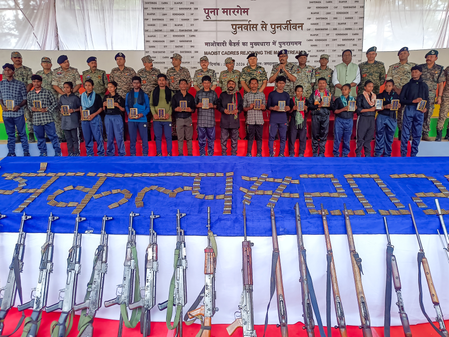
The government has asserted that a calibrated mix of strong security action and welfare-driven policies has effectively dismantled the decades-old Maoist insurgency in India.
Speaking in Parliament, Union Home Minister Amit Shah challenged long-held perceptions about the roots of Naxalism. He argued that the movement was driven more by ideology than poverty, citing historical data from the 1960s. According to him, regions like Naxalbari—where the movement began—had higher per capita income compared to some non-affected areas, undermining the belief that economic deprivation alone fuelled the insurgency.
The origins of the movement trace back to 1967, when radical Left leaders mobilised tribal peasants in the region near the Nepal border. Inspired by the ideology of Mao Zedong, the uprising sought to overthrow existing power structures and establish a “People’s Democratic Republic” through armed struggle. Although the initial revolt was contained, it triggered a wider insurgency that later spread across large parts of India.
Over time, the so-called “Red Corridor” extended across 12 states, impacting nearly 20 crore people. The conflict proved costly, with over 20,000 lives lost, including more than 5,000 security personnel.
Shah also dismissed claims that Maoist groups supported local communities economically. Investigations, he said, revealed that insurgents were collecting around ?240 crore annually as “tax” from civilians. Their activities—ranging from destroying infrastructure like roads to attacking industrial sites—further disrupted development and governance in affected regions.
He noted that most weapons used by insurgents were not imported, as often claimed, but looted from police stations and armouries. High-profile incidents, such as the 2005 attack in Bihar’s Jehanabad where hundreds of prisoners were freed, underscored the scale and coordination of their operations.
The report also refers to the role of policy and intellectual ecosystems during earlier years, including the National Advisory Council, which was set up in 2004 under the leadership of Sonia Gandhi.
Since 2014, the government led by Narendra Modi has pursued what it describes as a dual approach—combining strict counter-insurgency measures (“iron fist”) with rehabilitation and development initiatives (“velvet glove”).
On the enforcement side, a zero-tolerance policy toward insurgents and their support networks was implemented. On the rehabilitation front, surrender policies offered financial assistance, monthly stipends, education support for children, and housing benefits under schemes like PM Awas Yojana.
According to the government, this combined strategy has delivered measurable results. The number of Naxal-affected districts has dropped sharply from 126 in 2014 to just two in 2026, while the category of “most affected” districts has been reduced to zero. Many top insurgent leaders have either been neutralised or have surrendered.
Additional incentives have also been introduced to encourage community-level transformation, including financial rewards for Panchayats that become Naxal-free.
Framing the approach as a shift from violence to democratic participation, Shah emphasised that firm security action, alongside inclusive development, has restored governance and weakened insurgent influence—marking what the government describes as the end of a 56-year-long conflict.
With inputs from IANS




© Copyright
Reporter Post.All Rights Reserved |
Powered by: Aptilogic Software |
 |
Page rendered in 0.0097 seconds.
|
Page rendered in 0.0097 seconds.