Wed, October 21, 2026



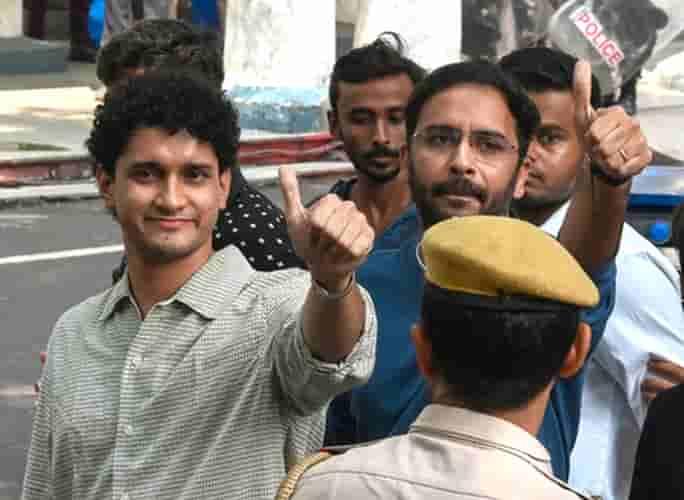
New Delhi— The Supreme Court on Monday declined to grant bail to student activists Umar Khalid and Sharjeel Imam in the alleged “larger conspiracy” case linked to the 2020 Delhi riots, while granting bail to five other accused who have spent over five years in custody.
Pronouncing the verdict, a Bench comprising Justices Aravind Kumar and Prasanna B. Varale held that the prosecution material disclosed a prima facie case against Umar Khalid and Sharjeel Imam, thereby attracting the statutory bar on bail under Section 43D(5) of the Unlawful Activities (Prevention) Act (UAPA).
The Justice Kumar-led Bench observed that, at this stage, the prosecution evidence and other material on record “does not justify their enlargement on bail,” noting that the material suggested their involvement at the level of planning, mobilisation, and issuance of strategic directions.
However, the apex court granted bail to Gulfisha Fatima, Meeran Haider, Shifa-ur-Rehman, Mohd Saleem Khan, and Shadab Ahmed, taking into account that they have remained in custody for more than five years.
The Bench emphasised that each bail application must be examined independently, as the accused did not stand on equal footing in terms of alleged culpability. “The hierarchy of participation requires the court to assess each application individually,” the Supreme Court said, holding that Umar Khalid and Sharjeel Imam were on a qualitatively different footing compared to the other accused.
Earlier, on December 10, the Supreme Court had reserved its judgment on a batch of special leave petitions challenging the Delhi High Court’s refusal to grant bail to the accused in the 2020 riots “larger conspiracy” case.
Opposing the bail pleas, Solicitor General Tushar Mehta, appearing for the Delhi Police, had argued that the violence was not a spontaneous communal clash but a “well-designed, well-crafted, orchestrated and preplanned” attack on the sovereignty of the nation. He relied on speeches, WhatsApp chats, and other material to contend that there was a “clear and discernible attempt to divide society on communal lines.”
The Solicitor General also submitted that delays in the trial were attributable to the accused, alleging non-cooperation and pointing out that each accused had taken several days to oppose the framing of charges. “In cases where it is difficult to defend on facts, the mechanism is to delay the trial and seek bail. This has become a pattern,” he had argued.
In September 2025, the Delhi High Court had dismissed the bail pleas of Khalid, Imam, and several other accused, holding that a prima facie case under the UAPA was made out against them.
—With inputs from IANS




© Copyright
Reporter Post.All Rights Reserved |
Powered by: Aptilogic Software |
 |
Page rendered in 0.0106 seconds.
|
Page rendered in 0.0106 seconds.