Wed, October 21, 2026


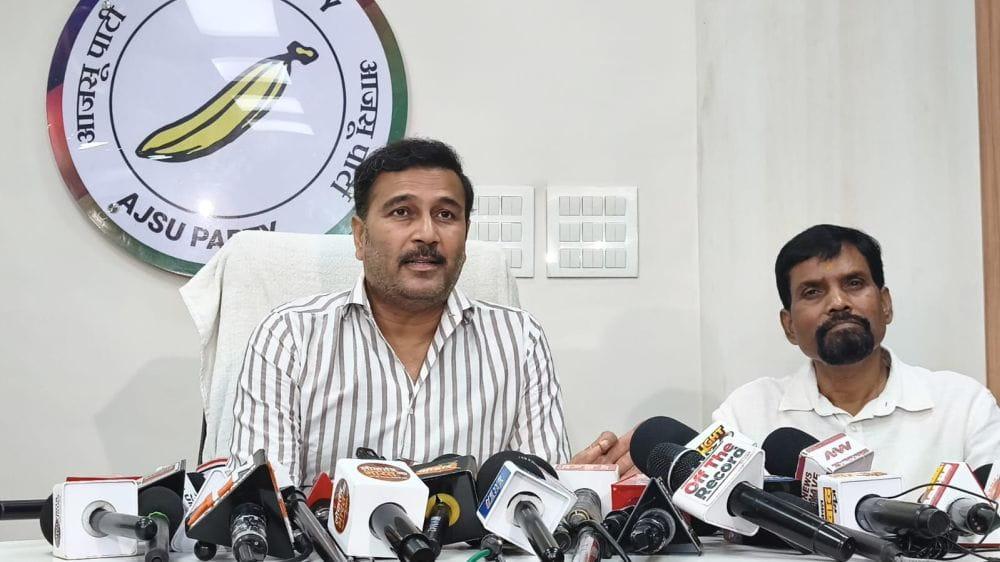
Photo: Reporter Post
AJSU Party Central President Sudesh Kumar Mahto has called for Jharkhand to be given the authority to impose a cess on mineral-bearing land, but with a clear condition that the money collected must be used exclusively for the development and welfare of people living in mining-affected areas.
Mahto presented the party's position on the Mines and Minerals (Development and Regulation) Act, mineral-bearing land cess, District Mineral Foundation Trust (DMFT) funds and the state government's budget expenditure. AJSU's chief spokesperson Devsharan Bhagat was also present.
Mahto said the movement for the creation of Jharkhand was fundamentally aimed at ensuring that the state's natural resources, including water, forests, land and minerals, contribute to improving the lives of local people. He argued that communities living in mineral-rich areas should receive the first and most direct benefits from the state's mineral wealth.
According to Mahto, provisions of the MMDR Act, following the Supreme Court's decision, appear to restrict the state's ability to independently impose a cess on mineral-bearing land. However, he pointed to Section 9D of the Act, which allows the Central government to permit states to impose such a cess subject to specified conditions and restrictions.
AJSU has urged the Central government to allow Jharkhand to impose the cess on the condition that the revenue be used for dedicated welfare schemes in mineral-producing areas.
Cess revenue should directly benefit mining communities
Mahto said the party does not support giving the state unrestricted access to such revenue. Instead, he proposed that clear legal conditions should ensure that the money is spent only on improving the lives of people living in mineral-rich regions.
He suggested that children studying in schools in mining areas should receive uniforms, books and scholarships. He also called for better nutrition for malnourished children and women, improved healthcare facilities and access to clean drinking water in every household.
He also raised allegations regarding the use of DMFT funds, claiming that irregularities involving funds of around Rs 10,000 crore had come to light. These allegations, however, are political claims made by the AJSU leader and would require verification from official records or investigative findings.
Mahto questions JMM's opposition to cess
Mahto also questioned the Jharkhand Mukti Morcha's opposition to the proposed cess. He alleged that illegal mining, particularly illegal coal production, was continuing with political and administrative protection.
He further claimed that legal coal production had become more expensive while illegal mining had been encouraged. According to him, annual growth in coal production was around 8 per cent before the cess issue arose but fell to around 2 per cent afterwards.
These claims formed part of Mahto's political criticism of the state government. He argued that the government should explain its position on the cess issue with facts and data rather than allowing the matter to become a political confrontation.
Budget utilisation raises questions
Mahto also challenged the state government's argument that not imposing a cess would create a shortage of funds for development schemes.
Citing the state's budget expenditure for the 2025-26 financial year, he claimed that the government could not utilise around 25 per cent of its total budget allocation. He said the Rural Development Department spent only around 40 per cent of its allocation, while the Tribal Welfare Department utilised around 52 per cent.
Similarly, he claimed that the Drinking Water Department spent around 56 per cent and the Health Department around 78 per cent of their respective allocations.
Mahto questioned why the government was citing a shortage of funds when several departments had not been able to fully utilise the money already allocated to them.
He argued that the issue was not always a lack of money but, in many cases, the ability and intent to spend it effectively on development projects.
AJSU calls for dialogue with Centre
Mahto said the AJSU Party favours dialogue and cooperation with both the state and Central governments on the issue. He said if the JMM-led government is serious about securing greater financial benefits from mineral resources, it should present its case before the Central government with supporting facts.
The AJSU's position is that Jharkhand should have the power to impose a cess along the lines of the DMFT model, provided strict safeguards ensure that the revenue directly benefits communities living in mineral-rich and mining-affected areas.
The proposal puts the focus not only on who controls mineral revenue, but also on whether mining-affected communities actually receive tangible benefits in the form of education, healthcare, nutrition, drinking water and other basic services.



© Copyright
Reporter Post.All Rights Reserved |
Powered by: Aptilogic Software |
 |
Page rendered in 0.0127 seconds.
|
Page rendered in 0.0127 seconds.