Sat, August 22, 2026

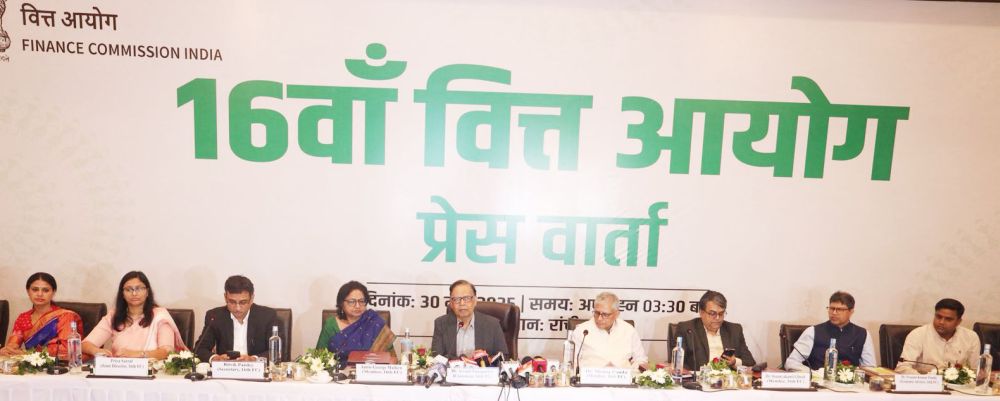
Ranchi: During a three-day visit to Jharkhand, the 16th Finance Commission, led by Chairman Dr. Arvind Panagariya, met with the state government and various political parties. In a press briefing, Dr. Panagariya emphasized that the state must conduct local body elections—including municipal and panchayat polls—by December 2025 to receive pending financial allocations. Failure to do so, he warned, would result in the lapse of these funds.
Dr. Panagariya clarified that matters such as “special state” status or financial packages do not fall within the commission’s jurisdiction. “Grants are sanctioned through the Union Budget and come with specific conditions,” he explained, adding that delays in these payments are beyond the commission’s control.
Addressing GST-related issues, he noted that Jharkhand has submitted a request to revise the GST compensation formula to offset revenue losses post-GST implementation. However, he refrained from commenting on which regions in Jharkhand may require special attention, stating that all decisions would be based on the commission’s set formula.
Jharkhand Finance Minister Radhakrishna Kishore submitted a demand for ?3.03 lakh crore over the next five years across 23 departments. He stressed that this funding is vital to uplift the state's socio-economic conditions. Kishore pointed out that GST compensation ceased in July 2022, and estimated that Jharkhand would incur losses of ?61,677 crore from FY 2025–26 to 2029–30.
He also raised concerns about forest-related allocations, stating that the current formula—allocating 10% weightage for forest cover in the 15th Finance Commission—is inadequate. He urged the inclusion of both dense and open forests in the calculation and called for increasing the state’s share in central taxes from 41% to 55%.
The state also sought central support for expanding irrigation across 14.19 lakh hectares and conserving rainwater. Kishore highlighted Jharkhand’s paradox: while rich in minerals, it lags in infrastructure, with an average road density of just 186 km per 1,000 sq km—far below the national average of 500 km.
Additional demands included support to boost per capita income and investments in higher education and agriculture. A comprehensive memorandum outlining these concerns and demands was submitted by Finance Minister Kishore, Urban Development Minister Sudivya Kumar Sonu, Excise Minister Yogendra Prasad, and former Finance Minister Rameshwar Oraon.
The state also flagged outstanding dues from various central schemes and entities: ?1.36 lakh crore from coal companies, ?1,300 crore under MGNREGA, and ?5,235 crore under the Jal Jeevan Mission.
Urban Development Minister Sonu reiterated the state’s intention to conduct municipal elections but argued that withholding 75–80% of funds was unfair. “The Centre should not treat states like elder and younger sons,” he said, adding that Jharkhand deserves special attention due to challenges like pollution, unemployment, displacement, and insurgency despite being rich in minerals.
The Finance Commission also expressed concern over the state’s financial governance, particularly the lack of audits for many Public Sector Undertakings (PSUs) over the past 10–12 years. Dr. Panagariya called this a serious shortcoming in Jharkhand's financial management.



© Copyright
Reporter Post.All Rights Reserved |
Powered by: Aptilogic Software |
 |
Page rendered in 0.1045 seconds.
|
Page rendered in 0.1045 seconds.