Sat, August 22, 2026


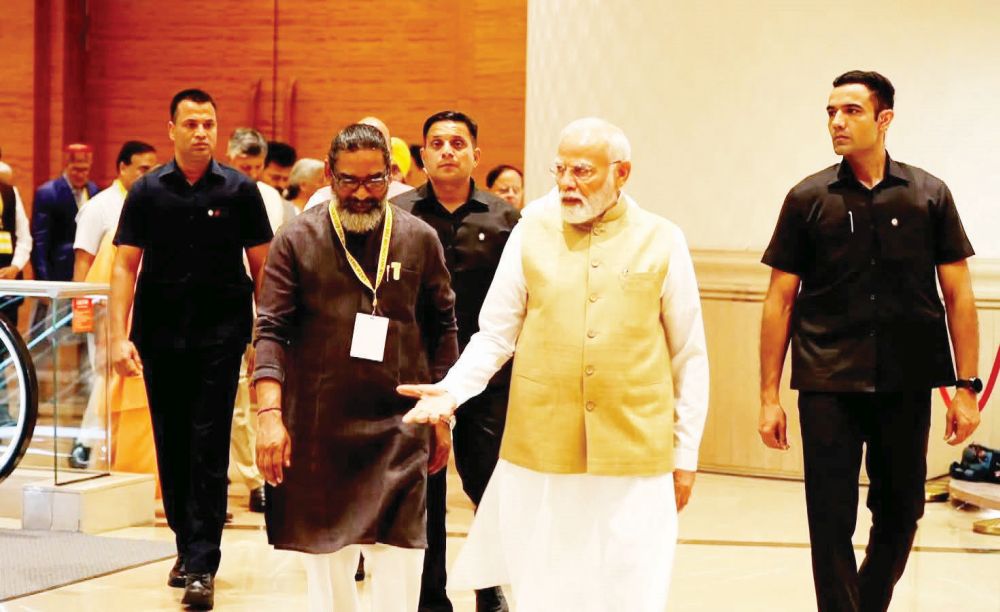
New Delhi/Ranchi: Chief Minister Hemant Soren participated in the 10th Governing Council meeting of NITI Aayog held in New Delhi on Saturday. Chaired by Prime Minister Narendra Modi, the meeting included key leaders such as Union Home Minister Amit Shah, NITI Aayog Chairman Amitabh Kant, several Chief Ministers, Governors, and senior officials from across India. Representing Jharkhand, CM Soren put forward vital demands and suggestions to ensure inclusive development and highlighted region-specific challenges requiring urgent central attention.
Soren stressed that the vision of a developed India cannot be achieved without first developing the states, particularly rural areas and villages. He said Jharkhand has been consistently working towards poverty eradication, women’s empowerment, youth skill development, farmer welfare, full literacy, economic growth, infrastructure development, and technological advancement. He called on the Prime Minister to address the unique needs of Jharkhand’s people.
He strongly urged for an amendment to the Coal Bearing Areas (CBA) Act, demanding that land acquired for mining be returned to the state after mining is complete. He pointed out that mining in Jharkhand has led to serious pollution and displacement, and companies owe the state over ?1.40 lakh crore in pending compensation. He demanded action against illegal mining and proposed that mining firms be mandated to install captive plants, ensuring that at least 30% of production is utilised within the state to generate local employment. He also emphasised Jharkhand’s significant coal-based methane reserves and their potential for power generation.
Soren recommended aligning CSR and DMFT funds of companies with the state’s development priorities. He called for expansion of railway services and proposed turning Sahibganj into a regional cargo hub. He also suggested constructing an additional bridge or dam over the Ganga River in Sahibganj and stressed the need to develop strategically important areas to reduce regional disparities. He advocated for a dedicated industrial and mining corridor to boost economic activity.
He urged that centrally sponsored schemes be adapted to suit individual state conditions. He highlighted several state-run welfare programmes like the Universal Pension Scheme, Maiyan Samman Yojana, and Abua Swasthya Yojana. He said Jharkhand is providing 5 kg of rice to 25 lakh families each month, Rs 5 lakh health insurance to 28 lakh families excluded from Ayushman Bharat, and up to Rs 15 lakh cover for 38 lakh poor families outside PMJAY. He proposed district-level health profiling as a national strategy to strengthen grassroots healthcare.
Soren raised concerns over delays in forest clearances due to Jharkhand’s vast forest cover and requested special assistance similar to that provided to northeastern states. He also highlighted how the provisions of CNT and SPT Acts are slowing industrial growth and require coordinated resolution with the Finance Ministry.
On fiscal issues, he demanded an increase in the states’ share of the divisible tax pool from 41% to 50%. He criticised the exclusion of cesses and surcharges from the divisible pool, which lowers states’ revenue. He noted that post-GST implementation in 2017, manufacturing states like Jharkhand have faced major revenue losses. Compensation ceased after June 2022, worsening the state’s financial condition.
He also expressed concern over the burden of paying for central security forces deployed in the state, arguing that these charges should be waived in the spirit of cooperative federalism. He acknowledged the reduction of Left-Wing Extremism (LWE)-affected districts from 16 to just 2 (West Singhbhum and Latehar) but urged that support continue for all 16 districts to ensure lasting peace.
On migrant welfare, Soren recalled the state-funded repatriation of workers stranded in Cameroon. He appealed for the Centre’s help with visa, safety, and travel costs for Indian workers abroad. Concluding, he emphasised that India’s development goals for 2047 cannot be met without robust support to states like Jharkhand. With greater central cooperation and resources, he said, both a developed Jharkhand and a developed India are achievable.
Accompanying the Chief Minister were Chief Secretary Alka Tiwari, Additional Chief Secretary to CM Avinash Kumar, Resident Commissioner Arva Rajkamal, and Planning Secretary Mukesh Kumar.




© Copyright
Reporter Post.All Rights Reserved |
Powered by: Aptilogic Software |
 |
Page rendered in 0.0982 seconds.
|
Page rendered in 0.0982 seconds.